
W’Bank to approve $500m Nigeria loan March

The World Bank is set to approve a fresh $500m loan to Nigeria next month to boost agricultural productivity, strengthen value chains, and create jobs across participating states.
Details of the planned facility are contained in the World Bank’s Project Information Document on the Nigeria Sustainable Agricultural Value-Chains for Growth, which Saturday PUNCH obtained from the bank’s website on Friday.
According to the document, the project has an estimated approval date of March 30, 2026. The document states that the project has a “Total Operation Cost” of $500m and “Total Financing” of $500m.
It further clarifies that the entire financing will be provided by the International Development Association, with “IDA Credit” amounting to $500m. According to the World Bank, the borrower is the “Federal Republic of Nigeria,” while the implementing agencies are the “Federal Ministry of Agriculture and Food Security and Participating States.”
The proposed development objective of the project is “to increase smallholder productivity and strengthen targeted agricultural value chains in participating states of Nigeria.”
Saturday PUNCH observed that the review process has progressed beyond the appraisal stage to the decision-making stage. Under the decision section of the document, the bank noted that “The review did authorise the team to appraise and negotiate,” signalling that the project has cleared a key internal hurdle ahead of final approval.
The World Bank highlighted Nigeria’s structural challenges, noting that “Creating more and better jobs while addressing food and nutrition insecurity remain some of Nigeria’s key development challenges.”
It added that agriculture remains the largest employer, with “roughly one-third of Nigeria’s working population relying on the sector for their livelihood,” while primary agriculture employs “about 21 million people.”
Despite its vast potential, the sector faces deep constraints. The Bank observed that Nigeria currently imports “approximately $10bn worth of food annually.”
The new project, also known as AGROW, will adopt what the Bank describes as “a private sector-led, public sector-facilitated approach to enhance smallholder farmer productivity, systematically integrate them into structured output markets, and promote value addition.”
According to the document, the initiative aligns with the Federal Government’s Renewed Hope Agenda and seeks to leverage agriculture as a driver of rural employment and income growth.
It is also positioned to mobilise private capital, as the document indicates that the operation is both “MFD-Enabling” and “Private Capital Enabling.”
Structurally, the $500m facility will be deployed across four major components. These include integrating smallholder farmers into competitive value chains, modernising smallholder production, strengthening policy and the enabling environment for private investment in inputs markets, and project coordination and monitoring.
Under the value chain integration component, the project will support aggregation models that connect smallholders with off-takers and agribusinesses, aiming to reduce transaction costs and improve supply reliability.
On the production side, the project will invest in research, extension systems, improved seeds, and digital agriculture platforms to raise yields and climate resilience.
The policy component will address systemic constraints in seed and fertiliser markets and promote responsible land-based investments through the Framework for Responsible and Inclusive Land-Intensive Agriculture. If approved as scheduled at the end of March, the $500m IDA credit will add to Nigeria’s growing portfolio of World Bank-loans.
The PUNCH earlier reported that Nigeria’s debt to the World Bank’s concessional lending arm, the International Development Association, surged by $1.9bn in just one year to reach $18.7bn as of December 31, 2025.
According to the IDA Management’s Discussion and Analysis for the period ended December 31, 2025, Nigeria’s exposure to the bank’s loan portfolio rose significantly from $16.8bn at end-2024, marking an 11.3 per cent year-on-year increase.
The latest figures placed Nigeria as the third-largest borrower in the IDA portfolio, behind Bangladesh ($23.0bn) and Pakistan ($19.4bn), among the top ten countries with the highest exposures.
The sharp rise shows growing reliance on multilateral concessional financing as the Federal Government navigates tightening fiscal space amid global market volatility.
As of June 30, 2025, Nigeria’s external debt stood at $46.98bn, according to the Debt Management Office. Of this amount, the World Bank Group accounted for $19.39bn—comprising $18.04bn from the International Development Association and $1.35bn from the International Bank for Reconstruction and Development.
This means the World Bank holds 41.3 per cent of the total, reinforcing its outsized role in funding Nigeria’s development programmes.

 The country’s total public debt increased to N153.29tn as of September 30, 2025, reflecting a steady build-up in both domestic and external obligations within three months, data released by the Debt Management Office on Friday has shown.
 The Managing Director and Chief Executive Officer of Dangote Petroleum Refinery & Petrochemicals, David Bird, has said the refinery is delivering measurable public health and environmental benefits through the production of Euro 5 standard fuels, positioning Nigeria among countries with the highest fuel quality specifications globally.
 The Edo State government on Thursday demolished a building in Amagba, Benin, where two suspected members of the Aye confraternity were arrested, while five others escaped.
 The naira has strengthened sharply in recent weeks, reaching one of its strongest levels in nearly two years, even as rising foreign portfolio inflows increase the risk of investor profit-taking later in the year, according to a macro update by CardinalStone.
 Banks and telecommunications operators in Nigeria have ended a four-year dispute over nearly N300bn owed for Unstructured Supplementary Service Data services, with the debt now fully cleared, the Association of Licensed Telecommunications Operators of Nigeria said.
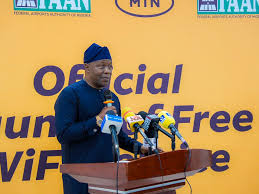 The Federal Airports Authority of Nigeria (FAAN), in partnership with MTN Nigeria, has launched free WiFi services at the Murtala Muhammed International Airport (MMIA) Terminal 2, Lagos, and the Nnamdi Azikiwe International Airport, Abuja.
 The Federal Capital Territory (FCT) Police Command has imposed a 12-hour restriction of movement across Abuja from 6 a.m. to 6 p.m. on February 21 to facilitate the conduct of the Area Councils’ elections.
 Sterling Financial Holdings Company Plc (“Sterling HoldCo” or “the Group”) has announced the commencement of the allotment process for its 2025 Public Offer of 12,581,000,000 ordinary shares of 50 kobo each at ₦7.00 per share.