CBN FX reforms drive return of foreign cards

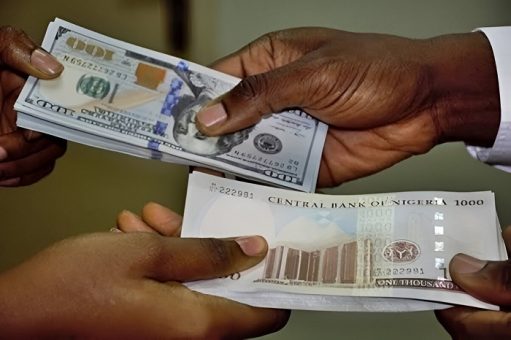
Foreign card usage is returning to Nigeria after years of restrictions, reflecting improved FX liquidity and renewed investor confidence. Recent CBN directives signal a shift from blanket controls to targeted safeguards, highlighting how exchange-rate reforms are reshaping Nigeria’s payments ecosystem, SAMI TUNJI reports

for some years, foreign card usage in Nigeria sat at the crossroads of policy caution and market stress. International transactions on naira debit cards were suspended as the country battled acute foreign-exchange shortages, weak external buffers, and rising arbitrage between official and parallel markets. Businesses and travellers were pushed towards cash, informal channels and offshore cards, while foreign cardholders visiting Nigeria faced limited access to local payment infrastructure.

That backdrop explains why the Central Bank of Nigeria’s latest directive on foreign card transactions is being read not as an isolated compliance update, but as part of a longer arc of reforms that began after the current management of the Central Bank of Nigeria assumed office in September 2023. Since 2023, the CBN has liberalised the FX market, unified exchange rates, and halted monetary financing of fiscal deficits. Clearing of the $7bn FX backlog marked a turning point for investors. Nigeria returned to international capital markets in December 2023, issuing new debt instruments. Ratings agencies responded by upgrading the country’s outlook, while multilateral lenders described the reforms as necessary for sustainability.

The World Bank recently described the measures as “bold interventions” that address structural weaknesses. Nigeria’s sovereign risk spread fell to its lowest point since January 2020, reflecting improved investor sentiment. Portfolio managers have noted the shift. “Nigeria appears to be back in business as long-awaited economic reforms take shape,” said East Capital’s Emre Akcakmak. He highlighted improved liquidity and flexibility in profit repatriation as key factors in renewed interest.

At the heart of the latest directive on foreign card transactions is a requirement for banks and non-bank acquirers to implement multi-factor authentication for such transactions, a step the regulator says is aimed at strengthening security while improving the user experience for international cardholders. The measures are designed to ensure uninterrupted and efficient local currency withdrawals, payments and transfers for users of foreign-issued payment cards across Nigeria, particularly tourists and Nigerians in the diaspora visiting the country. This is a notable shift from an earlier period when the priority was conserving scarce dollars.

The new rules did not emerge in a vacuum. Foreign capital inflows reached $20.98bn in the first 10 months of 2025, representing a 70 per cent increase over total inflows recorded in 2024 and a 428 per cent jump from the $3.9bn recorded in 2023. That improvement in inflows has allowed the CBN to cautiously loosen constraints around card usage, both domestically and abroad, without reopening the door to the kind of speculative pressure that defined earlier years.

It was against this backdrop that Nigerian banks began lifting restrictions on card transactions abroad. Three Tier-1 lenders and a mid-tier bank, United Bank for Africa, FirstBank, GTBank and Wema Bank, announced the resumption of international transactions on their naira debit cards. For customers, the announcements marked the end of an extended moratorium. For regulators, they signalled confidence that FX liquidity had improved enough to support controlled outbound spending.

While customers welcomed the return of international card functionality, the CBN moved to tighten the operating framework around foreign card usage within Nigeria. According to the apex bank, the new framework is designed to improve access to funds, enhance transaction security and boost the overall user experience for foreign cardholders, without compromising financial integrity.

Inside the CBN’s new card rules

The operational details of the policy were outlined in a circular signed by the CBN’s Director of Financial Policy and Regulation, Dr Rita Sike. Financial institutions were instructed to apply multi-factor authentication to all withdrawals and online transactions exceeding $200 per day, $500 per week and $1,000 per month, or their naira equivalents. The same requirements apply across automated teller machines, point-of-sale terminals and virtual payment channels.

The circular states: “In this regard, banks and non-bank acquirers shall implement multi-factor authentication for all withdrawals and online transactions exceeding $200 per day, $500 per week, and $1,000 per month (or their equivalent).” It further directs institutions to ensure compliance with approved cash withdrawal limits for ATM transactions.

Beyond authentication thresholds, the CBN emphasised transparency and settlement discipline. Banks and acquirers were instructed to “clearly communicate the applicable exchange rate, which shall be market-driven and based on the prevailing official rate, as well as other associated charges to users. Transactions should only be completed after the user has accepted the terms (with evidence obtained).”

The regulator also required institutions to maintain sufficient liquidity to settle transactions and to ensure that merchants are settled in local currency. Transaction monitoring systems must be calibrated to detect unusual patterns in the use of foreign cards across all terminals, while know-your-customer and anti-money laundering controls for merchants handling foreign card payments are to be strengthened.

Merchants, in turn, are required to ensure that card-present transaction receipts are properly signed and that valid identity documents are requested where a transaction appears suspicious. Banks and non-bank acquirers were also directed to report suspicious transactions to the Nigeria Financial Intelligence Unit and to recalibrate fraud-monitoring systems to reduce false declines on legitimate transactions.

Taken together, the measures reflect a balancing act. The CBN is reopening channels for foreign cards and international spending, but within a framework that prioritises traceability, system resilience and regulatory oversight. For foreign cardholders, the changes promise broader acceptance and fewer failed transactions. For regulators, they are a safeguard against abuse at a time when confidence in the FX market is still being rebuilt.

Liquidity, confidence and the return of cards

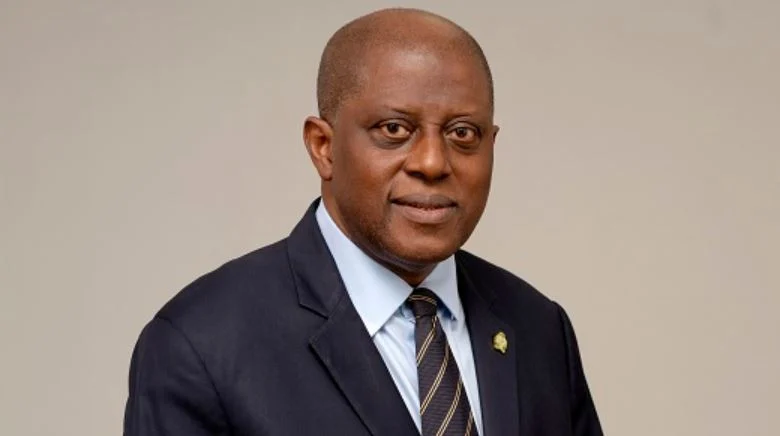
The broader economic context explains why the CBN now appears more comfortable easing restrictions around card usage. According to the CBN Governor, Olayemi Cardoso, Nigeria’s external sector strengthened decisively in 2025, with the current account balance rising by over 85 per cent to $5.28bn in the second quarter from $2.85bn in the first quarter. Foreign reserves stood at $46.7bn by mid-November, providing more than 10 months of forward import cover. Analysts at United Capital Research have expressed optimism that Nigeria’s external reserves will continue their steady ascent in the final quarter of 2025, buoyed by stronger oil export receipts, robust diaspora remittances, and a favourable trade balance.

“With the reserves position strengthening, the CBN will have greater flexibility to sustain its interventionist approach in the FX market. This, in turn, should help to maintain relative stability in the naira across both official and parallel markets,” analysts at Cowry Assets said in a recent weekly market report.

For market operators, these metrics matter because they speak directly to the sustainability of policy choices. The President of the Association of Bureaux De Change Operators of Nigeria, Dr Aminu Gwadabe, said reforms in the FX market are yielding results, including the reactivation of international transactions on naira-denominated debit cards, which he said is benefiting travellers and businesses.

Also, the CBN’s Quarterly Statistical Bulletin for the first quarter of 2025 revealed that total foreign-exchange utilisation across the economy increased by 19 per cent quarter-on-quarter to $9.3bn in Q1 2025, representing a 39 per cent year-on-year growth. The rise was driven mainly by a surge in invisible transactions, such as services and transfers, which grew by 54 per cent quarter-on-quarter to $4.5bn. This category’s share of total FX usage expanded to about 48 per cent, up from 37 per cent in the fourth quarter of 2024.

These numbers indicate that the country is gradually rebuilding foreign-exchange buffers. Analysts at FBNQuest added that ample liquidity and attractive yields in the domestic market have supported robust investor participation in government securities auctions, further strengthening market stability and investor confidence in the naira.

Analysts broadly agree that the return of card functionality is tied to improved liquidity and reduced arbitrage. The Head of Financial Institutions Ratings at Agusto & Co, Ayokunle Olubunmi, said improved liquidity in the FX market supported banks’ decision to reactivate naira cards for global transactions. “The moderating premium on parallel market transactions and the reduced arbitrage opportunities are also responsible for the decision,” he said.

Data from recent months support that assessment. Nigeria attracted average monthly FX inflows of about $5.96bn from May 2025, with inflows in that month rising by 62 per cent month-on-month, driven largely by increased participation from domestic and foreign investors. Diaspora remittances, estimated at about $23bn annually, continue to provide a stable source of foreign exchange.

In a note to investors, analysts at Financial Derivatives Company Limited attributed rising inflows to a combination of higher oil prices and multiple FX channels activated by the CBN. These include new products to support diaspora remittances, licensing of additional international money transfer operators, adoption of a willing buyer, willing seller FX model and improved naira liquidity access for authorised dealers.

The impact is also visible in reserve quality. Net foreign-exchange reserves stood at $23.11bn at the end of last year, up from $3.99bn at the end of 2023. Cardoso said the improvement reflected deliberate policy choices, including a reduction in short-term FX liabilities and efforts to rebuild confidence. “This improvement in our net reserves is not accidental; it is the outcome of deliberate policy choices aimed at rebuilding confidence, reducing vulnerabilities, and laying the foundation for long-term stability,” he said.

For consumers and businesses, the return of foreign card access and international naira card usage does not eliminate FX risk or policy uncertainty. But it signals a shift from blanket restrictions to more targeted controls, anchored on liquidity, monitoring and transparency. In that sense, the re-entry of foreign cards into Nigeria’s payment ecosystem is less about convenience alone and more about what it says about the direction of FX policy.

Fuel price competition good for consumers – NNPC

GCEO NNPC Ltd, Mr Bashir Bayo Ojulari addresses the staff of the company during his inaugural town hall meeting held at the NNPC Towers, on Thursday. CREDIT: NNPCLThe Group Chief Executive Officer of the Nigerian National Petroleum Company Limited, Bayo Ojulari, on Sunday, assured Nigerians that ongoing price competition in the downstream petroleum sector will ultimately benefit consumers.

He described current market tensions as a natural consequence of Nigeria’s transition from total import dependence to domestic refining. “Where there is healthy competition, the buyers are the ultimate beneficiaries.

And I think for us, we need to keep in mind that the market will stabilise. After a while, there’ll be some tension, because we’re going through a major transition,” Ojulari told journalists after briefing President Bola Tinubu in Lagos.

The NNPC boss made the remarks against the backdrop of an intense price war that has seen petrol prices crash from over N1,200 per litre in November 2024 to as low as N739 per litre at some retail outlets in December 2025, driven primarily by competition between Dangote Refinery, NNPC, and independent marketers.

“At the end of the day, I can tell you that Nigerians on the street are going to be the beneficiaries,” Ojulari declared. Clarifying NNPC’s role in the deregulated market, Ojulari emphasised that the company is no longer responsible for petroleum product pricing or regulation under the Petroleum Industry Act.

“The first thing you have to know is that the PIA did something fundamental. Before the PIA in 2021, which rolled in 2022, everything was under NNPC, including some regulations. The PIA divided the roles of regulation from what I will call the business,” he explained.

Ojulari added, “The NMDPRA is responsible for all downstream regulation and midstream, as you know, and the NUPRC is responsible for all upstream regulations. So it’s very important that Nigerians understand that post-PIA, we as NNPC, we are not regulators.”

He stressed that NNPC has been instituted by the PIA to become “a commercial company, which means a company that needs to compete profitably and be successful profitably.”

Ojulari disclosed that NNPCL no longer receives federation allocations and must raise finance independently “like any other business.”

Nigeria’s downstream petroleum sector has been gripped by fierce competition since September 2024, when Dangote Refinery, Africa’s largest single-train refinery with 650,000 barrels per day capacity, began producing petrol locally.

According to the National Bureau of Statistics, the average retail price of Premium Motor Spirit fell by N153 per litre between November 2024 and November 2025—from N1,214.17 to N1,061.35, driven by supply improvements and stronger competition.

The price war intensified dramatically in December 2025 when Dangote slashed its ex-depot price from N970 to N699 per litre, forcing other players to follow suit or risk losing market share.

MRS filling stations, Dangote’s retail partner, began selling at N739 per litre nationwide, while NNPC retail outlets dropped prices from N875 to between N825 and N840 per litre depending on location. Independent marketers followed, with some selling as low as N865 per litre.

Data from Petroleumprice.ng showed that Dangote Refinery made over 20 price adjustments in 2025 alone. The rapid price reductions created significant challenges for petroleum marketers who purchased products at higher prices and now must sell at a loss or lose customers entirely.

IPMAN confirmed that “price competition now determines customer loyalty,” with its spokesperson, Chinedu Ukadike, noting that “any marketer unwilling to adjust prices risks losing patronage and facing mounting bank interest costs.”

Ojulari described NNPCL as “the supplier of last resort,” working closely with all key downstream players, including Dangote Refinery, in which we have an interest, to ensure product availability.

“For us as NNPC, our focus is to generate more production. As we generate more production, we believe there’ll be more production to feed the refineries as much as possible. We also believe the additional production will create more flexibility in terms of the ability for downstream players to be able to participate effectively,” he stated.

Ojulari acknowledged that having major refineries like Dangote and NNPC’s rehabilitated facilities operating simultaneously has disrupted market equilibrium.

“To be honest with you, by the time you have a refinery like Dangote in-country, which has not been there before, with NNPC refinery now under a major review, such a huge refinery in the country, you can expect the market will be impacted right now.

“All we need to do together is to walk through that reality,” he said. “Reality is a great thing to have a major refinery in Nigeria, supplying West Africa and other parts of the world. The question now is, how do we then ensure that the market forces stabilise so that everyone can be okay?”

He emphasised that NNPCL would “let the NMDPRA manage the issue of competitiveness,” noting that “competitiveness is not easy, and I think in these early stages, we are seeing a lot of tension with willing buyer, willing market.”

Before Dangote’s entry, Nigeria’s petroleum sector was characterised by near-total import dependence despite being Africa’s largest oil producer. NNPC held a virtual monopoly on imports and distribution under a heavily subsidized regime.

The removal of fuel subsidies by President Tinubu in May 2023 led to pump prices skyrocketing from around N195 per litre to over N1,030 per litre by October 2024, worsening economic challenges for Nigerians facing inflation exceeding 30 per cent.

The Federal Government attempted to restart the Port Harcourt refinery in November 2024, but imports remained essential until Dangote’s production ramped up significantly in late 2024 and early 2025.

Ojulari said he briefed President Tinubu on NNPC’s production achievements in 2025, revealing that oil production has risen from 1.5 million barrels per day last year to over 1.7 million barrels per day currently. “Some of those are underpinned by very structural changes within the organization,” he explained.

Gas production also increased from 6.5 billion standard cubic feet to over seven billion standard cubic feet daily. The GCEO said NNPC aims to achieve at least 1.8 million barrels per day in 2026, stepping toward President Tinubu’s target of two million barrels per day by 2027 and attracting over $30bn in additional investment by 2030.

Ojulari also disclosed that NNPCL has successfully completed welding of the main line of the Ajaokuta-Kaduna-Kano gas pipeline, including crossing the River Niger. “You remember sometimes in summer, we were able to cross the River Niger, which has been a struggle for many years.

“By completing this main line, what that means now is that we can begin to connect, make all the connections to the main line, which we will do in the earlier parts of next year,” he said.

The 614-kilometer AKK pipeline will bring gas to northern Nigeria for industrialisation, fertilizer plants, and power generation when commissioned in early 2026. “We believe that we are in a good state to be able to commence the implementation,” Ojulari stated.

FirstBank introduces premium seating at Carnival Calabar 2025

First-Bank logoFirstBank has officially announced the introduction of the first-ever private premium seating area at the Carnival Calabar & Festival 2025, which it is sponsoring.

According to the bank, the highlight of its sponsorship is the construction of a 500-seater premium bleacher, designed to provide comfort, safety, and an elevated viewing experience for carnival enthusiasts.

Speaking on the sponsorship, Acting Group Head, Marketing and Corporate Communications, FirstBank, Olayinka Ijabiyi, noted that the carnival aligns with the bank’s First@Arts initiative, a platform dedicated to supporting the creative arts value chain across Nigeria.

He said, “We recognise the transformative power of the arts, including carnivals, in inspiring people and strengthening national unity. For more than 131 years, we have supported platforms that promote self-expression, social reflection, and cultural exchange. Our investment in the Carnival Calabar & Festival demonstrates our commitment to preserving the nation’s rich cultural heritage through First@Arts.

“As part of our sponsorship this year, we are introducing the first-ever private 500-seater premium bleacher to further elevate the carnival experience. This exclusive seating is designed to provide exceptional comfort and an unforgettable viewing experience for attendees.”

The Chairman of the Cross River State Carnival Calabar Commission, Gabe Onah, also commented on FirstBank’s sponsorship, saying, “FirstBank’s involvement is a strong demonstration of private-sector support for culture and tourism. This partnership not only enhances the overall quality of the carnival but also strengthens its global appeal.”

The Carnival Calabar & Festival 2025 is officially marketed by Okhma Global Limited, which is responsible for brand partnerships, promotional engagements, and ticket sales.

FX reserves add $4.39bn in one year

CBN headquartersNigeria’s external reserves grew by $4.39bn between December 23, 2024, and December 23, 2025, according to data sourced from the Central Bank of Nigeria.

As of Tuesday, December 23, the FX reserves stood at $45.24bn, higher than $40.85bn on the same day last year. The reserves have maintained an upward trajectory in the last few months of the year, although there were periods of decline.

The external reserves closed 2024 at $40.87bn and dipped to $39.72bn in January 2025. They fell further to $38.41bn in February, continued the downward trend in March to $38.30bn, and declined to $37.93bn in April. The drop in reserves during this period was attributed to increased debt-servicing commitments.

In a statement during this period, the CBN said, “Reserves have continued to strengthen in 2025. While the first-quarter figures reflected some seasonal and transitional adjustments, including significant interest payments on foreign-denominated debt, underlying fundamentals remain intact, and reserves are expected to continue improving over the second quarter of the year.”

Data from the CBN revealed that Nigeria’s total debt service payments amounted to $540m in January 2025 and $276m in February 2025. This means that a total of $816m was spent on foreign debt servicing in the first two months of the year, The PUNCH reported.

In May, the reserves clawed back some gains to settle at $38.45bn, but those gains were erased in June as the reserves closed at $37.21bn. This wrapped up a first half in which external reserves shed $3.67bn due to debt servicing and the CBN’s interventions in the foreign exchange market.

In the second half of the year, the reserves maintained steady appreciation, rising to $39.35bn in July and crossing the $40bn mark in August to close at $41.30bn. They appreciated by about two per cent in September to close at $42.35bn.

The upward movement continued in October to $43.19bn, while in November the reserves closed at $44.66bn. The accretion continued into December until the 15th day of the month, when the first decline in over two months was recorded.

The reserves dropped to $45.32bn from $45.47bn. Thereafter, they fell to $45.27bn before a day-on-day decline of $57.05m brought them to $45.21bn as of December 17, 2025. Some of the losses have since been recovered, with the reserves standing at $45.24bn as of Tuesday.

Providing insight into the growth in the FX reserves in October, the CBN Governor, Olayemi Cardoso, said the clearing of the foreign exchange backlog and sustained efforts to improve transparency in the FX market were instrumental.

The PUNCH reported that Cardoso made the remarks at the inaugural CBN Governor Annual Lecture Series held at the Lagos Business School under the theme, ‘Next Generation Leadership in Monetary Policy and Nation Building.’

He stressed that credibility and trust were essential to attracting long-term investment, saying, “If we are a going concern, and if we expect people to trust and invest in our economy, we must keep our promises. That action contributed in no small way to the rise in our reserves. People invest when they see credibility and transparency.”

In November, The PUNCH reported that the CBN governor said Nigeria’s foreign reserves had surged to their strongest level in seven years, hitting $46.7bn as of November 14, 2025. Cardoso, who was represented by the Deputy Governor in charge of Economic Policy, Dr Muhammad Abdullahi, said the reserves had reached a new high for the first time since 2018, attributing the resurgence to renewed investor confidence, improved oil receipts, and stronger balance-of-payments inflows.

While not entirely enthusiastic about the sources of accretion to the FX reserves, the Managing Director of Financial Derivatives, Bismarck Rewane, said robust reserves would support FX supply and reduce pressure on the naira.

Speaking at the annual Parthian Economic Discourse 2025 held in late November, Rewane said, “External reserves must be viewed in the context of debt. The recent rise in reserves was due to the Eurobond issuance.”

He added that while diaspora remittances had become an important support for the FX reserves, they were being threatened by AI-induced job losses among Nigerians abroad.

In their macroeconomic review, analysts at Afrinvest Research commended the Cardoso-led CBN for its innovations in the FX market, which they said had supported the external reserves.

“With a net addition of roughly $4.4bn between January and November 2025, foreign reserves hit a multi-year high of $45.4bn on December 9, 2025, implying nearly 11 months of import cover versus an eight-month comfort-level floor for low-income countries,” they said, while cautioning that the pre-election year could prompt investors to adopt a more cautious stance toward the Nigerian market.

Nigeria not at war, Edun tells investors

Olawale EdunThe Minister of Finance and Coordinating Minister for the Economy, Wale Edun, has assured investors that the country’s recent joint security operation with the United States in Sokoto will not destabilise markets, but rather reinforce economic confidence.

Speaking in a statement on Sunday, Edun emphasised that the operation, conducted on Christmas Day, was intelligence-led and targeted solely at terrorist elements threatening national stability and communities.

The PUNCH reports that US President Donald Trump had made good on his threat of military action against terrorists in Nigeria — a threat he made in November that financial markets reacted to negatively.

Trump, on his Truth Social platform, had said, “Tonight, at my direction as Commander in Chief, the United States launched a powerful and deadly strike against ISIS terrorist scum in northwest Nigeria, who have been targeting and viciously killing, primarily, innocent Christians, at levels not seen for many years, and even centuries.

‘I have previously warned these terrorists that if they did not stop the slaughtering of Christians, there would be hell to pay, and tonight, there was. The Department of War executed numerous perfect strikes, as only the United States is capable of doing.

“Under my leadership, our country will not allow radical Islamic terrorism to prosper. May God bless our military, and Merry Christmas to all, including the dead terrorists, of which there will be many more if their slaughter of Christians continues.”

The military strikes have since been framed as an operation approved by the Federal Government, with more strikes likely.

In his statement on Sunday, Edun stressed that Nigeria is not at war with itself or any other country, and that the action is part of ongoing efforts to safeguard citizens and protect economic activity.

“The operation in question was precise, intelligence-led, and focused exclusively on terrorist elements that threaten innocent lives, national stability, and economic activity. Far from destabilising markets or weakening confidence, such actions strengthen the foundations of peace, protect productive communities, and reinforce the conditions required for sustainable growth. Security and economic stability are inseparable; every effort to safeguard Nigerians is, by definition, pro-growth and pro-investment,” he said.

The finance minister also underscored Nigeria’s solid macroeconomic performance, noting GDP growth of 3.98 per cent in the third quarter of 2025, following a 4.23 per cent expansion in Q2. Inflation has continued its downward trend for the seventh consecutive period, falling below 15 per cent reflecting improving price stability.

He maintained, “Our financial markets remain resilient. Domestic and international debt markets are stable and functioning efficiently, supported by prudent fiscal management. Over the past year, Nigeria has received credit rating upgrades from Moody’s, Fitch, and Standard & Poor’s—clear, independent endorsements of the strength of our reforms and the credibility of our economic direction. We have maintained fiscal discipline, prioritised efficiency, and protected macroeconomic stability—demonstrating resilience in the face of external shocks.

“As President Bola Tinubu noted in his address last week, our overarching objective for 2026 is to consolidate the gains of 2025, strengthen Nigeria’s economic resilience, and continue building a sustainable, inclusive, and growth-oriented economy.

“The actions we take today—on security, reforms, and fiscal discipline—are aligned with that goal. As markets reopen on Monday, 29 December 2025, investors can be confident that Nigeria remains focused, reform-driven, and committed to stability. The fundamentals are strengthening, the policy direction is clear, and the resolve of this administration—to protect lives, secure prosperity, and grow the economy—is unwavering.”

As markets reopen on Monday, Edun reassured investors that Nigeria remains open for business, anchored in peace, and firmly focused on the future.

The PUNCH reports that when Trump issued the threat of a military strike in early November, both the naira and the Nigerian Exchange reacted bearishly. The naira slid from its 2025 peak of N1,421.73/$ to N1,436.34/$ — a sharp 1.03 per cent decline, or N14.61, on November 3, 2025. At the parallel market, the naira also weakened to N1,455.00/$.

On the same day, the Nigerian Exchange Limited’s All-Share Index contracted by 0.25 per cent to settle at 153,739.11 points, bringing year-to-date gains to 49.37 per cent. The trading trend also led to a loss of N245.88bn in market capitalisation.

At the bond market, Cowry Assets Management indicated that appetite for Nigerian Eurobonds weakened, with average yields expanding by five basis points to 7.70 per cent. This was indicative of bearish sentiment and defensive positioning in the offshore debt space, driven by prevailing macroeconomic headwinds and heightened geopolitical risk aversion across emerging market credit.

Business movers and shakers in 2025

The last 365 days have been very eventful, no doubt. Across the nation’s socioeconomic landscape, there are telltale signs and visible fixtures that speak to the fact that it has been a rollercoaster ride of some sort judging by the rapidity of the assault of events that took place in the course of the year.

From business deals that shot someone’s fortunes skywards to others that went awry to policy initiatives that miscarried and other decisions that positively impacted the economic fundamentals, this year, with the benefit of hindsight, has seen a lot of economic players recording major milestones, building their business empires and ultimately pushing the nation’s economic wheel to lofty heights.

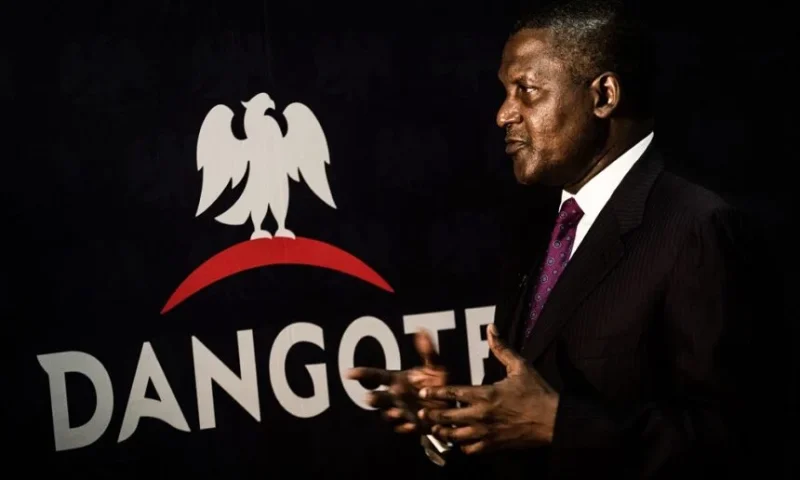
Amongst the highfliers this past year is business mogul, Alhaji Aliko Dangote. Expectedly, the richest man in Africa has continued to prove bookmakers right that he has his own winning ways as far as building economic fortunes in the continent of Africa.

Amongst the highfliers who made much of an impact is business mogul, Alhaji Aliko Dangote. Expectedly, the richest man in Africa has continued to prove bookmakers right that he has his own winning ways as far as building economic fortunes across the continent of Africa.

According to the Bloomberg Billionaires Index, Dangote’s wealth rose by $2.25 billion to $30.3 billion as of October 24, 2025, placing him 75th among the world’s 100 richest people and the only African on the list.

The latest boost in his fortune comes two weeks after Dangote Cement, a key subsidiary of the Dangote Group, officially launched operations at its new 3-million-tonne-per-year cement plant in Attingué, Côte d’Ivoire. Covering 50 hectares, the plant is one of the conglomerate’s largest facilities outside Nigeria.

Back home, Dangote has maintained a strong presence in Nigeria’s oil and gas industry, following the successful launch of his $20 billion, 650,000 barrels-per-day refinery in the Ibeju-Lekki Free Zone, Lagos.

The refinery, inaugurated in May 2023, began producing diesel in January 2024, while petrol production started in September 2024 after delays caused by crude oil supply challenges.

Dangote recently announced plans to list the refinery on the Nigerian Exchange (NGX), selling between 5 and 10 percent of its shares within the next year — a move similar to what he did with Dangote Cement and Dangote Sugar Refinery.

He also disclosed that the Nigerian National Petroleum Company (NNPC) Limited, which currently holds a 7.2 per cent stake, may increase its equity once the refinery’s next expansion phase begins.

In a bold move, the billionaire revealed that the refinery aims to raise output to 1.4 million barrels per day, surpassing the world’s largest refinery in Jamnagar, India, which has a capacity of 1.36 million bpd.

Meanwhile, Dangote’s aggressive expansion into fuel distribution has stirred reactions in the downstream sector. In June, the refinery unveiled plans for a nationwide fuel distribution scheme, supported by the acquisition of 4,000 compressed natural gas (CNG)-powered tankers.

However, the plan has drawn criticism from industry stakeholders. The Petroleum Products Retail Outlets Owners Association of Nigeria (PETROAN) warned that the refinery’s forward integration could create a monopoly and lead to massive job losses within the sector.

Of course one investment dear to Dangote, Dangote Refinery which dominated the news amidst price war with traditional oil marketers, including the Nigerian National Petroleum Corporation Limited (NNPCL).

The conflict began when Dangote Refinery slashed the price of petrol, offering it at N739 per litre, significantly lower than the N828 per litre offered by other marketers, and currently selling at N699, a move seen as a threat to the business interests of traditional marketers, who have long dominated the industry.

The battle has also taken a legal turn, with Dangote Refinery suing the Nigerian Midstream and Downstream Petroleum Regulatory Authority (NMDPRA) over the issuance of import licenses to marketers, which also led to the unceremonial exit of the boss at the NMDPRA, Farouk Ahmed, following accusations by Dangote that the former spent about $5 million on the secondary school education of his four children in Switzerland, an expenditure way above his earnings as a public servant.

Abdul Samad Rabiu

Another major player within the nation’s economic landscape is Abdul Samad Rabiu, the Chairman of the BUA Group, who started 2025 with an estimated net worth of $5.1 billion, and of December 2025 increased to approximately $8.5 billion, meaning his fortune has grown by approximately $3.4 billion over the year, thus placing him as the fourth-richest person in Africa and around the 390th globally, driven by strong performance in his listed companies, BUA Cement Plc and BUA Foods Plc.

The year also saw Rabiu approving $20.7m in cash rewards for 1,768 long-serving employees, reinforcing a strong employee-first culture, thus reinforcing his reputation as one of Africa’s most employee-focused business leaders.

The rewards were announced on December 13, 2025, during the BUA Night of Excellence Long Service Awards held at Eko Hotel and Suites in Victoria Island, Lagos. The annual event recognises commitment and performance across the group’s cement, food and manufacturing businesses.

Under the structure approved by Rabiu, five employees received $691,000 each, while another five were awarded $345,000. Dozens more received sums ranging from $3,450 to $13,810, depending on years of service and role within the company.

Mike Adenuga

Dr. Mike Adenuja Jrn, the chairman of the Pan-African telecommunications company, Globacom, who featured prominently on the Forbes ranked as the fifth richest Africa as 2025, had $6.8 billion in his portfolio during the period under review.

Ranked #592 billionaire in the world today, Adenuga, arguably Nigeria’s second richest person, built his fortune in telecommunications and oil production, made good this year as Conoil, where he owns 74%, demonstrated its strength and strategic clarity in Nigeria’s downstream petroleum industry, announcing a proposed dividend payout of ₦2.428 billion for the 2024 financial year.

The proposed dividend, amounting to 350 kobo per 50 kobo ordinary share, was unveiled at the Company’s 55th Annual General Meeting held on Friday, 19 December 2025, drawing commendation from shareholders amid a persistently challenging economic environment.

The Company recorded a remarkable 60.5 percent growth in revenue, rising from ₦201.4 billion in the previous year to ₦323.1 billion in 2024. Total assets also expanded significantly by 18 percent, increasing from ₦97.5 billion to ₦114.9 billion.

According to the Adenuga, these results were driven by timely strategic decisions, disciplined cost management, and a steadfast focus on operational efficiency. He underscored the importance of the Company’s workforce, noting that Conoil’s progress continues to be powered by the competence, commitment, and innovative capacity of its people. The Company remains deliberate in investing in its human capital, fostering an inclusive workplace that promotes growth, fairness, and professional fulfilment.

Femi Otedola

Just like the past year, billionaire businessman, Femi Otedola played in the top hemisphere in the business ecosystem in the year as he made lots of moves to further grow his economic fortunes. One of such moves described in some quarters as the stuff of mafia was when the oil magnate pulled out a trump card after acquiring shares worth N14.8 in First HoldCo Plc a company where he owns a majority share already.

The acquisition further strengthens his position in one of Nigeria’s largest lenders, giving him a combined 17.56% controlling stake of the group.

Yuletide: Bank assures digital service

ECO BANKEcobank Nigeria has assured customers of uninterrupted access to banking services throughout the year-end holiday period via its secure and robust digital platforms.

In a statement on Friday, the bank also urged customers to remain vigilant against fraud and scams during the festive season.

Speaking on the development, the Head, Products & Analytics, Consumer & Commercial Banking, Ecobank Nigeria, Victor Yalokwu, said the bank’s digital channels and over 35,000 Ecobank Xpress Point (agency banking) locations nationwide will remain fully available to support customers throughout the yuletide and year-end holiday period.

He noted that customers will continue to enjoy a wide range of services during the period, including local and international funds transfers, bill payments and airtime top-ups, merchant and QR payments, balance inquiries and account statements, as well as cardless cash withdrawals via ATMs.

“Ecobank encourages customers to leverage these digital solutions for safe, fast, and efficient banking, especially during the festive season when convenience and reliability are essential. While physical branch operations may be subject to adjusted working hours in line with public holidays, customers can be assured that Ecobank’s digital platforms are designed to deliver uninterrupted service and enhanced security at all times.

“Ecobank remains committed to providing innovative financial solutions and exceptional customer service, and we wish all our customers a joyful festive season and a prosperous New Year,” he said.

Yalokwu also cautioned customers to remain vigilant against fraudsters and scammers during the period.

“Before you wrap up the year, tighten your security. December brings online sales, travel, and year-end distractions—this is exactly when scammers are most active. From fake festive deals to cloned merchant sites and suspicious messages, staying vigilant helps keep your money safe,” he said.

He advised customers to shop only on trusted websites, never share their PINs, passwords, or one-time passwords, avoid banking on public Wi-Fi networks, be cautious of urgent or emotionally charged messages, and regularly review their account activity.

The PUNCH reports that Ecobank Nigeria is a member of the Ecobank Group, the pan-African banking institution with operations in 33 African countries and international offices in London, Paris, Beijing, and Dubai.

States, LGs repay N547.5bn bank debts

debtStates and Local Government councils reduced their bank borrowings by about N547.52bn in one year, as Federation Account inflows surge, according to findings by Saturday PUNCH.

Figures from the Central Bank of Nigeria’s latest Quarterly Statistical Bulletin reveal that the banking sector’s “claims on state and Local Governments” fell from N2.68tn in June 2024 to N2.13tn in June 2025.

This means sub-national governments collectively cut their indebtedness to commercial and merchant banks by 20.4 per cent year-on-year.

Further analysis shows that in January 2024, banks’ exposure to states and councils stood at N2.73tn. One year later, in January 2025, the figure had dropped to N2.44tn, indicating that about N292bn was cleared during that period.

The outstanding balance then ticked up slightly in February 2025 to N2.59tn and eased again to N2.55tn in March 2025. By April and May 2025, exposure steadied around N2.44tn–N2.45tn, before a sharp decline to N2.13tn in June 2025, representing the largest single-month adjustment during the year.

Year-on-year, June provided the clearest shift. The banks were owed N2.68tn in June 2024, but the balance had fallen by more than half a trillion naira a year later.

Month-on-month, the drop from May 2025’s N2.45tn to June 2025’s N2.13tn amounted to about N313bn, signalling an aggressive push to unwind bank obligations at the end of the second quarter amid high interest rates and rising FAAC allocations.

It was observed that throughout 2024, the Central Bank of Nigeria’s Monetary Policy Committee aggressively tightened policy, lifting the Monetary Policy Rate from 18.75 per cent at the start of the year to about 27.50 per cent by November, through multiple successive hikes to rein in inflation and stabilise the exchange rate.

In 2025, the MPC largely held rates steady at 27.50 per cent for much of the year, signalling a cautious pause after the earlier tightening cycle as inflation began to moderate. However, in September 2025, the committee delivered its first rate cut in five years, trimming the MPR to 27.00 per cent, reflecting slowing price pressures and a gradual shift toward supporting broader economic activity.

By November 2025, the CBN reaffirmed the 27.00 per cent benchmark, balancing the need to sustain disinflation with financial stability concerns as borrowing costs remained high but gradually more accommodative.

The high interest rate likely pushed sub-nationals to reduce borrowing as FAAC allocations rise. Further analysis of FAAC records shows a jump in what state governments and local government councils jointly received in 2025 compared with 2024, reflecting the scale of the revenue windfall now flowing through the federation account.

Data from the Office of the Accountant-General of the Federation show that states and local governments jointly received N12.67tn in 2025, up from N8.96tn in 2024. These figures exclude the 13 per cent derivation fund for oil-producing states. The difference of N3.71tn represents a 41.4 per cent surge in year-on-year statutory inflows to the two tiers of government.

When the 13 per cent derivation fund is added, the gap remains just as stark. States and councils together received N14.28tn in 2025, compared with N10.31tn in 2024, meaning an extra N3.98tn, or about 38.6 per cent more than the previous year.

The derivation component alone rose from N1.35tn in 2024 to N1.62tn in 2025. A closer look at the breakdown shows that states were the biggest beneficiaries in absolute terms.

State governments’ FAAC share rose from N5.19tn in 2024 to N7.31tn in 2025, an increase of N2.13tn, equivalent to a 41 per cent rise year-on-year. Local government councils followed the same pattern, with allocations rising from N3.77tn in 2024 to N5.35tn in 2025 — a jump of N1.58tn, or 41.8 per cent.

The trend was visible month after month. In January 2024, states received N396.69bn, but by January 2025, this had risen to N498.50bn. The figures continued to climb through the year, peaking at N727.17bn for states in October 2025, before closing the year at N601.73bn in December 2025, still well above the N549.79bn recorded in December 2024.

Local governments recorded the same step-change. Councils received N288.93bn in January 2024, compared with N361.75bn in January 2025. Allocations crossed the N500bn mark in the final quarter of 2025, reaching N529.95bn in October, the highest for the year, before ending at N445.27bn in December 2025, higher than the N402.55bn shared in December 2024.

The 2024 figures show that allocations to councils typically sat in the N267bn–N294bn band for much of the first half of that year, while state allocations hovered around N366bn–N403bn.

In contrast, the 2025 data show that councils rarely received below N387bn and states seldom below N498bn in any month. Overall, total FAAC allocations to all three tiers of government rose from N13.91tn in 2024 to N20.28tn in 2025, while the total distributable revenue, including derivation, climbed from N15.26tn to N21.89tn. States and councils together accounted for the bulk of that increase.

The surge in inflows also seems to drive the decrease in the bank debt of states and councils. In a recent statement by the acting Director of Communication and Stakeholders Management at the Nigeria Extractive Industries Transparency Initiative, Mrs Obiageli Onuorah, the agency noted that the report highlighted the financial strain on states due to debt repayments, despite record-high disbursements from the Federation Accounts Allocation Committee.

According to the statement, a report by NEITI showed that several states with high debt burdens also ranked lower in FAAC allocations, raising concerns about their fiscal sustainability and ability to fund critical projects.

“The report noted that many states with high debt ratios were in the lower half of the FAAC allocation rankings but ranked higher for debt deductions, raising concerns about their debt-to-revenue ratios and overall fiscal health,” the statement read.

The Director-General of Nigeria’s Debt Management Office, Ms Patience Oniha, recently called on state governments to adopt Public-Private Partnerships and prioritise tax revenue generation over borrowing to fund infrastructure projects.

She made these remarks during a one-day workshop in Lagos, organised under the States Action on Business Enabling Reforms Programme with World Bank support. Oniha said, “Borrowing should not be the major way to source funds.  You must increase your revenues by increasing your tax revenues.

“Public-private partnerships can help improve Nigeria’s economy by attracting private sector investment and expertise to develop infrastructure and deliver public services. This reduces the financial burden on the government, accelerates project delivery, and often results in higher quality outcomes. PPPs can also create jobs, stimulate local businesses, and foster innovation.”

LCCI flags engineering, power gaps hindering industrialisation

LCCIThe Lagos Chamber of Commerce and Industry has warned that the country cannot industrialise or expand manufacturing without solving its electricity challenges. It called on the Federal Government to refocus Nigeria’s development strategy on engineering, technical skills and a reliable power supply.

The President of the LCCI, Leye Kupoluyi, said Nigeria’s failure to prioritise engineering capacity and technical competence continues to weaken the manufacturing sector and slow industrial growth.

In an interview with The PUNCH, Kupoluyi stated that countries classified as developed earned that status through their engineering strength, manufacturing capacity and skilled human capital, despite mineral resources.

He said, “When an economy is an industrial economy, we say this country is a developed country. For a country to qualify as a developed country, it must have strength in engineering and technical knowledge. That is basic.”

Kupoluyi, an engineer, said nations that dominate global trade built their influence on manufacturing and technical skills, stressing that no country can become developed by relying on imports.

“You can’t take over the world without having that skill, without having that technical edge, without having engineering capacity. It’s not just possible,” he said.

The LCCI president noted that excessive dependence on imports prevents any country from being regarded as developed, regardless of its natural resource endowment.

“When you have to import everything that makes your economy tick, nobody will ever refer to that country as a developed country. Mineral resources would not qualify any country to be a so-called developed country,” Kupoluyi said.

He added that global examples show that countries with limited mineral resources but strong manufacturing bases are consistently ranked as developed economies.

“It is human resources, it is technical, it is engineering, it is skill, it is manufacturing. We don’t need to contest that at all,” he said.

Kupoluyi also linked engineering development to youth empowerment, citing Nigeria’s success in technology-driven sectors such as financial technology.

He said, “Take FinTech in Nigeria. That has been 100 per cent taken over by our youth. We have more than five unicorns in FinTech.”

He added that young Nigerians are driving innovation and wealth creation through technology-based enterprises, highlighting digital platforms transforming services such as food delivery and logistics.

“That is the power of technology. That is the power of knowledge. That is what we just need to focus on,” Kupoluyi said.

On power supply, the LCCI president said electricity remains a major constraint to manufacturing and engineering businesses but noted that the decentralisation of power is a positive step.

He said, “What the government has done to decentralise power is a good step in the right direction. Sub-nationals should take advantage of it, being able to provide power in their own environment.”

Kupoluyi urged the government to encourage off-grid and renewable energy solutions, arguing that leaving the national grid is not necessarily a sign of failure but an economic decision.

“You can go off the grid for economic reasons. When you can produce power cheaper than what you are getting from the grid, what do you do? You move out,” he said.

He disclosed that his organisation operates off-grid using solar energy, with significant installed capacity, stating, “We are off the grid here. Everything is here. I have close to 100 kVA solar power.”

Kupoluyi called for incentives to support the adoption of renewable energy, including tax reliefs, import incentives for batteries and possible cashback schemes.

“There might be an incentive to go green. There might be an incentive for bringing those batteries to Nigeria. In some cases, they will give you a cashback incentive,” he said.

He argued that widespread adoption of decentralised power solutions would boost production and support industrialisation.

“That is where they need this power. Tomorrow, at your apartment, you will put it on solar. I think that is the way to go,” Kupoluyi added.

Meanwhile, power sector challenges undermined industrial growth, according to a policy brief by the Director of the Centre for Promotion of Private Enterprise, Dr Muda Yusuf.

Yusuf said Nigeria’s power sector remains one of the most difficult areas of economic reform, despite several interventions.

“Nigeria’s power sector remains one of the most challenging areas of the country’s economic reform agenda,” he said.

He noted that the sector faces “deep structural, financial, and governance challenges,” including tariff distortions, weak investor capacity, transmission bottlenecks, and a persistent liquidity crisis.

Yusuf said the failure to implement cost-reflective tariffs has entrenched subsidy dependence and widened the sector’s financing gap, pushing sector debt to about N4tn.

“The current trajectory, characterised by rising sector debt, is fiscally unsustainable without deeper structural corrections,” he warned.

He added that weaknesses across the power value chain, from gas supply to distribution, continue to limit electricity supply and reliability.

Yusuf called for phased tariff reforms, stronger governance, recapitalisation of distribution companies, transmission reforms and greater support for decentralised and renewable power.

He said, “Power sector reform remains central to Nigeria’s economic competitiveness, industrial growth and social welfare.”

FIRS accredits PwC as system integrator for e-invoicing

Federal Inland Revenue Service

The Federal Inland Revenue Service has accredited PwC Nigeria as a system integrator for Nigeria’s mandatory e-invoicing system under the Monitoring, Billing, and Settlement platform.

PwC announced the accreditation in a statement, saying the accreditation is part of broader efforts by the tax authority to transform digital tax administration, increase transparency, and improve the integrity of transaction-level tax reporting in Nigeria.

Commenting on the development, Partner and Tax & Regulatory Services Leader at PwC Nigeria, Chijioke Uwaegbute, said e-invoicing integrates tax compliance directly into everyday business activities.

“E-invoicing embeds tax compliance directly into everyday business activity. As transaction data moves into real-time digital systems, organisations must be able to rely on that data for tax reporting, audit, and regulatory review,” Uwaegbute said.

He added that the accreditation reinforces PwC’s role in supporting organisations to comply and report with confidence.

“This accreditation reinforces PwC’s role in helping organisations build trust, comply, and report with confidence. We combine deep tax and regulatory expertise with technology to ensure e-invoicing processes are accurate, empowering businesses to comply,” he stated.

Uwaegbute also noted that the e-invoicing mandate reflects global trends toward increased transparency and real-time oversight in tax reporting, saying, “Our role is to support businesses through this shift by helping them manage complexity, protect value, and build trust across the tax ecosystem.”

The statement noted that treating e-invoicing purely as a technology exercise could expose organisations to data inconsistencies and control gaps. Managing these risks, it said, requires tax expertise to be embedded in the design, configuration, and governance of invoicing systems from the outset.

Under the MBS framework, organisations are required to transmit invoice data to the FIRS platform in real time, embedding tax reporting directly into business operations, with invoice data and control processes applied at the point transactions occur.

The MBS platform replaces traditional paper-based invoicing with a digital validation framework aimed at reducing manual errors, improving oversight, and enabling real-time regulatory review. Accredited system integrators are responsible for ensuring secure and reliable connectivity between taxpayers’ systems and the FIRS platform.

Also commenting, Partner and Tax Technology Leader at PwC Nigeria, Tim Siloma, said technology alone is not sufficient for effective e-invoicing compliance.

“Technology can automate invoicing. However, interpreting tax requirements and managing risk require tax expertise. e-Invoicing works best when tax rules, data controls, and enterprise systems are designed together,” Siloma said.

He explained that PwC’s tax technology capability brings tax advisory expertise into technology execution, enabling organisations to manage complexity and maintain control as compliance becomes embedded into operations.

With the accreditation, PwC Nigeria will work with organisations to review invoicing and reporting processes, implement required system integrations, and support ongoing compliance as e-invoicing requirements continue to evolve.

With mandatory e-invoicing, the Federal Government is aiming to tighten its tax administration system, reduce revenue leakages, and align Nigeria’s fiscal processes with global best practices.