Morning Recap: AFCON heartbreak for Nigeria, US visa shock, FG–ASUU deal, other top stories

Nigeria end historic AFCON scoring streakNigeria woke up on Thursday to a mix of sports disappointment, major policy decisions, and international developments with far-reaching implications.

From the Super Eagles’ narrow miss at the AFCON semi-finals to a long-awaited agreement between the Federal Government and Academic Staff Union of Universities, as well as fresh concerns over US immigration policy, these are the top stories making headlines this morning, Thursday, January 15, 2026.

Here are the top stories:

1. Nigeria miss out on AFCON final as Morocco advance

Nigeria’s Super Eagles failed to secure a place in the final of the 2025 Africa Cup of Nations after losing 4–2 on penalties to Morocco following a goalless draw in regulation and extra time.

Morocco will now face Senegal in the final of the tournament.

Meanwhile, fans have continued to criticise the officiating in Nigeria–Morocco clash.

Following the semi-final defeat, Nigerian fans expressed dissatisfaction with the performance of referee, Daniel Nii Laryea, citing concerns over officiating decisions during the match.

The complaints centred on perceived inconsistencies and missed calls.

2. FG, ASUU unveil agreement to end strikes

The Federal Government and the Academic Staff Union of Universities unveiled a new agreement aimed at ending recurring industrial actions and prolonged university closures.

The deal follows years of negotiations over the 2009 FGN-ASUU agreement and is expected to improve lecturers’ welfare and funding for federal universities.

3. FG orders banks, fintechs to remit VAT on service fees

The Federal Government has directed banks and financial technology companies to remit Value Added Tax (VAT) on service fees.

The directive is part of efforts to enhance revenue collection and ensure compliance with existing tax laws in the financial sector.

4. US visa shockwave hits intending Nigerian immigrants

A new U.S. policy directive under former President Donald Trump may delay visa processing for about 5,000 intending Nigerian immigrants.

In a related development, the United States has suspended immigrant visa processing for Nigeria, Ghana, and 73 other countries, according to an official list released by U.S. authorities.

5. FG confers national honours on fallen hero Uba, other soldiers

The Federal Government has conferred national honours on fallen soldier Brigadier General Musa Uba and other military personnel in recognition of their service to the nation.

These honours were awarded during activities marking the Armed Forces Remembrance Day in Abuja.

The government said the gesture was to acknowledge the sacrifices of officers and men of the Nigerian Armed Forces who paid the supreme price in the defence of the country.

FG bars signature bonus refund as oil reforms continue

Heineken Lokpobiri 2The Federal Government has warned prospective investors in the 2025 oil licensing round that any errors, miscalculations, or disappointments arising from the bidding process will be borne entirely by the companies involved, stressing that there will be no refunds of signature bonuses or exchanges of oil assets under any circumstances.

The warning was issued by the Minister of State for Petroleum Resources (Oil), Heineken Lokpobiri, at the 2025 Nigerian Upstream Petroleum Regulatory Commission pre-bid conference held in Lagos on Wednesday. The conference, which attracted a large turnout both physically and online, was aimed at educating prospective bidders on available assets, the legal framework, and the risks involved in the licensing process.

Lokpobiri said the era when oil licences were acquired for speculation, prestige or resale was over, adding that licences are government assets that must be actively developed.

“I’ve had obligations to solve so many problems following the 2020 bid round. The government received several representations from people who won those bids; some of them came for refunds of their bidding fees. It is clearly stated that if you go for any bid round, the registration fee is not refundable. But some people came to my office demanding a refund of the bidding fees,” he said.

The minister also recounted how some bidders complained that the assets awarded to them did not meet their expectations and demanded alternative acreages.

“A few of these bidders have also come to say they should be given other acreages and that the one they bid for was not good enough, ‘so give us another one’. I want to state very clearly that the PIA does not provide for asset exchanges or refunds on these grounds,” Lokpobiri said.

According to him, once a bid is completed and an award is made in line with the law, the technical and commercial risks rest entirely with the bidder.

“The government under any law has no obligation to refund your bidding fees or your signature bonuses because you find out that eventually you didn’t see oil or you only found gas,” he declared.

Lokpobiri warned against holding oil blocks without development, describing licences as instruments of value creation rather than personal trophies.

“What I’ve discovered in my over two years at the ministry is that some people have had licences for 20 years, and they are very proud, going around the world with the nicest suits and saying, ‘Look, I have a licence.’ What value have you added to yourself?” he asked.

The minister emphasised that the 2025 licensing round is firmly anchored on the Petroleum Industry Act, noting that Sections 73 and 74 of the law require petroleum prospecting licences and petroleum mining leases to be awarded through transparent, competitive, and non-discriminatory processes based on financial, technical, and work programme parameters.

He urged companies without sufficient capital to collaborate with credible partners to ensure the viability of their bids, adding that hydrocarbons would remain central to global energy supply for decades.

“Fossil fuel resources will never go away. They will constitute over 50 per cent of global energy sources for the foreseeable future,” Lokpobiri said.

Echoing the minister’s position, the Chief Executive of the NUPRC, Oritsemeyiwa Eyesan, said reforms introduced under the Petroleum Industry Act have eliminated practices that previously encouraged asset hoarding.

“Hitherto, the PIA, we had instruments that supported block sitting. With the advent of the PIA, if you do not work your blocks, it will be taken from you. And many of the assets on offer today are recovered as fallow fields,” she said.

Eyesan also announced a revision of the signature bonus approved by President Bola Tinubu to reduce entry barriers, alongside adjustments to other fees payable before first oil. She added that the commission plans to commence the 2026 bid round almost immediately, running preliminary processes alongside the 2025 round to ensure continuity.

Beyond licensing, Eyesan unveiled a sweeping reform agenda aimed at accelerating oil production, improving regulatory efficiency, and tightening hydrocarbon accountability, as the Federal Government targets crude oil output of three million barrels per day by 2030.

At a separate stakeholder engagement in Lagos, she disclosed that the commission had commenced a 90-day programme to fast-track approvals for near-ready Field Development Plans, well interventions, rig mobilisation, and other “quick-win” opportunities capable of delivering early barrels.

“The commission, going forward, will issue quarterly progress reports. Let us therefore bring all high-impact shut-in fields for approval,” she said, noting that a long shut-in asset had recently been brought back on stream.

Eyesan said her vision for the upstream sector rests on three pillars: production optimisation and revenue expansion; regulatory predictability and speed; and safe, governed, and sustainable operations. She added that the agenda aligns with President Bola Tinubu’s Renewed Hope Agenda to raise production to two million barrels per day by 2027 and three million barrels per day by 2030.

According to her, the commission will publish Service Level Agreements outlining approval timelines, deploy digital workflows for permitting and data submissions, and run regulation “like a service” through transparent, time-bound decisions.

She urged operators with mature opportunities to submit projects before the end of the first quarter of 2026 and announced the creation of a monthly CCE–Operators Leadership Forum involving NNPC, OPTS, IPPG, and emerging producers.

“Going forward, the commission will be measured by faster and more predictable approvals, higher and more secure production, credible licensing, disciplined acreage performance, world-class health, safety, and environment outcomes, and trusted data integrity,” Eyesan said.

Dangote refinery begins 24-hour petrol loading operations

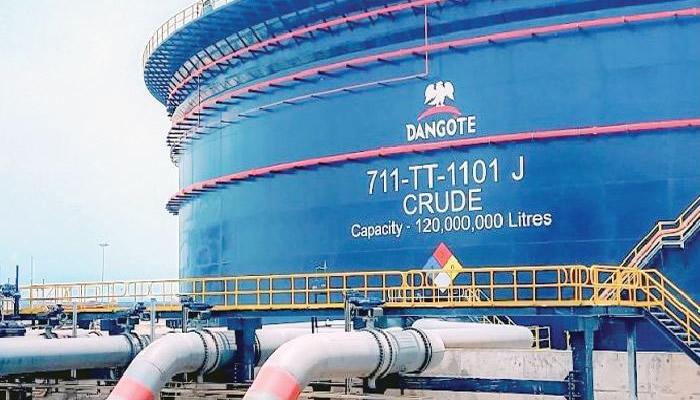
DANGOTE REFINERYThe Dangote Petroleum Refinery has commenced night-time loading operations as it intensifies efforts to sustain a daily supply of more than 50 million litres of Premium Motor Spirit (petrol) across Nigeria, signalling a major shift to full 24-hour operations at Africa’s largest refinery.

The move comes as the refinery continues to ramp up production, stabilise logistics, and strengthen fuel security, while countering speculation around maintenance activities and supply disruptions. Originally designed for daytime evacuation, the facility has now expanded loading to night hours to ensure that rising output is matched with uninterrupted offtake.

Speaking during a press briefing at the refinery on Wednesday, the Managing Director, David Bird, said the transition to round-the-clock loading had become necessary to meet market demand and improve turnaround time for product evacuation.

According to him, the refinery is now meeting the 50 million litres daily petrol requirement in both production and evacuation.

“What I’m incredibly proud of is that, in the second half of 2025, while we were still ramping up capacity of our conversion units and downstream units, we were still able to deliver 50 million litres a day, more frankly than 52 million litres on some occasions,” Bird said.

He added, “We’re already doing nighttime loading. So it’s a 24-hour operation. We have celebrated over 50 million litres of offtake as well, which means over a thousand trucks progressing through the gate and through the gantry. Really learning and continuously improving our logistics and our turnaround time of getting those trucks through.”

Bird emphasised that sustaining high output is not only about production but also efficient offtake. “It’s volatile. We see a dip on weekends and so forth. It all depends on demand and available stocks; if not, we can export. But for me, the primary objective is to demonstrate that we can continue to produce over 50 million litres a day and then see where true market demand in Nigeria lies.”

He linked stable supply to economic activity, noting, “Having a lower price and an abundance of supplies will stimulate demand, which is a good thing. That will continue to stimulate economic activity by having stable, affordable, clean fuels available. I do expect the demand to increase as a result of this stability and abundance of our product.”

Bird also highlighted the refinery’s operational flexibility, explaining that it can maintain output even during planned maintenance. “We have continued to deliver 50 million litres a day. We have built this flexibility into our system so that individual units can be taken out for maintenance and still meet finished product demand,” he said.

The MD described the Dangote refinery as a highly flexible merchant refinery, capable of producing petrol through multiple routes, including crude processing, intermediate feedstocks, and blending components.

“This is not just a single crude processing plant. It is a very flexible, resilient production process where we can make our finished product from crude, from intermediates through our conversion and treatment units, or by bringing in blending components,” Bird said.

This flexibility, he added, allows the refinery to supply the Nigerian market consistently while maintaining export capability, a requirement for operating on a global merchant refining scale.

“We have the requirement to be able to always export our finished product. By definition, that means we have to make world-quality fuels and ensure that we can land our product competitively anywhere in the world. We must make sure our production is compliant with Euro-5 gasoline and diesel,” he said.

Bird also credited the refinery with transforming Nigeria’s fuel market. “Nigeria has gone from fuel scarcity to fuel abundance. Beyond volume, we are supplying cleaner, Euro V-compliant fuels, ending West Africa’s long-standing reputation as a dumping ground for substandard petroleum products.”

NGX lists 3.16 billion UBA shares

NGX_Exchange_Identity

The Nigerian Exchange Limited has officially listed an additional 3,156,869,665 ordinary shares of United Bank for Africa Plc on its Daily Official List, marking a step in strengthening the bank’s capital base and deepening liquidity in the Nigerian capital market.

The listing follows the successful conclusion of UBA’s recent rights issue exercise, which offered shareholders one new ordinary share for every thirteen ordinary shares held at a price of N50.00 per share.

The NGX confirmed the formal listing in a letter dated 12 January 2026, addressed to UBA and signed by Godstime Iwenkehai, Head of the Issuer Regulation Department at NGX.

In the letter, Iwenkehai stated, “Following the submission of all post-approval documents, please be informed that United Bank for Africa Plc’s Rights Issue of 3,156,869,665 ordinary shares of 50 kobo each at N50.00 per share on the basis of one new ordinary share for every thirteen ordinary shares held was formally listed on the Daily Official List of Nigerian Exchange Limited on Monday, 12 January 2026.”

The listing of these shares increases UBA’s total outstanding shares on NGX from 41,039,305,642 ordinary shares to 44,196,175,307 ordinary shares. This injection of additional shares represents a substantial enhancement of UBA’s market capitalisation and is expected to significantly improve liquidity in the trading of the bank’s stock.

UBA’s Group Managing Director and Chief Executive Officer, Oliver Alawuba, welcomed the confirmation, describing it as a clear demonstration of investor confidence in the bank.

“We welcome the formal confirmation from NGX on the listing of our rights issue shares. This successful transaction reflects strong investor confidence in UBA’s financial strength, governance, and growth strategy,” Alawuba said. He added, “Needless to say, the additional capital will further support our Pan-African and global expansion and enhance our capacity to deliver sustainable value to all stakeholders.”

The recently concluded rights issue raised N158bn for UBA, which, when combined with the N239bn raised in November 2024, has increased the bank’s total capital base to N513bn. This latest capital infusion ensures that UBA’s qualifying capital now comfortably surpasses the N500bn minimum requirement set by the Central Bank of Nigeria for banks with international authorisation, solidifying its position as one of Nigeria’s leading financial institutions.

Petrol price hike looms as crude crosses $66/barrel

Excess Crude AccountThe pump prices of Premium Motor Spirit (petrol) and other refined petroleum products, including Automotive Gas Oil (diesel), and Household Kerosene, among others, may spike soon as crude oil, the major feedstock for refined fuel, crossed $66/barrel on Wednesday.

Brent, the global benchmark for crude, traded above $66 on Wednesday, as other oil grades also appreciated in price, heightening concerns that the cost of refined products might balloon in the coming days.

Industry players fingered the instability in Iran and Venezuela, coupled with the actions of the United States on Venezuela, and its recent threat to Iran. They noted that the cost of crude may continue to rise unless there is stability in these two nations that produce large volumes of the commodity.

Oil marketers projected that crude oil prices may reach $80/barrel, following the uncertainties in the international market. Crude is the major feedstock for the production of refined petroleum products. The foreign exchange rate is another factor that mainly affects the cost of imported fuel

The National President of the Petroleum Products Retail Outlets Owners Association of Nigeria, Billy Gillis-Harry, confirmed these developments in the sector while speaking with The PUNCH on Wednesday, as he noted that fuel consumers should brace for imminent price hikes.

“It is simple economics, crude oil is the main feedstock for refined petroleum products, so as the price of crude oil grows, the costs of these refined products are bound to rise. We have only one major refiner in Nigeria currently, and no one can certainly say whether the plant will retain its prices amid the spike in crude.

“Imported petrol will, of course, rise, and the same is expected of domestically produced PMS. The instability in Iran and Venezuela is definitely playing out. Even if the US decides to sell the crude produced from Venezuela at a reduced cost, it may not bring down the global crude oil prices.

“So, as fuel consumers, we should brace for hikes in the cost of refined products. It may not be now, but a sustained hike in crude oil prices would definitely lead to a spike in the costs of refined products domestically,” Gillis-Harry stated.

He noted that the instability in the Middle East may force the price of crude to hit $80 before the end of the month, adding that this may bring more FX to the Federal Government, but would raise the pump prices of refined products.

“There is apprehension that the price of crude doesn’t cross $80/barrel before the end of the month, because with the way things are going, and the seeming daily increases in crude oil price lately, the cost might get to that.

“Of course, the government would make more foreign exchange earnings as a result of this, but this will mean higher prices of refined petroleum products, and the masses would have to bear the brunt. This is the situation in the oil and gas sector right now,” Gillis-Harry explained.

The global oil industry has experienced several developments that pushed oil prices above the $60/barrel level at which it traded about a month ago. On Wednesday, The PUNCH reported that global oil prices surged on Tuesday as markets reacted to escalating drone attacks on Russia’s Novorossiysk terminal, which handles about two per cent of global daily oil supply, according to a report by Oilprice.com.

The report stated that Brent crude rose from $63 per barrel on Monday to trade around $65.14 on Tuesday evening, while US West Texas Intermediate climbed to $60.75, up from $59, representing a gain of about $2.1 per barrel.

The spike followed reported disruptions at the Caspian Pipeline Consortium infrastructure, a key export route for Kazakhstan’s crude oil operated by Western oil majors, including Chevron and Shell, raising concerns of a potential supply squeeze.

Reuters reported that two oil tankers waiting to load crude from some of Kazakhstan’s largest oilfields were hit by drones at the CPC marine terminal near Novorossiysk on Russia’s Black Sea coast.

As crude maintains the recent spike in price, data from the Major Energies Marketers Association of Nigeria on Wednesday indicated that the landing cost of imported petrol has remained stuck at rates above the ex-depot price of N699/litre of the Dangote Petroleum Refinery.

MEMAN disclosed in its bulletin that the landing cost of petrol dropped to N754.96 on Wednesday, from N758 last week. The association noted that Dangote’s gantry price was still N699 per litre, representing a difference of about N44.

But oil marketers stated that the prices of both domestically produced fuel and imported fuel would rise in the coming days if crude oil continues to spike in price. According to them, the government has to work hard to get Nigeria’s refineries under the management of the Nigerian National Petroleum Company Limited, working

Wole Oluyede vows to appeal PDP primary nullification in Ekiti

The winner of the Peoples Democratic Party, PDP, governorship primary in Ekiti State, Dr Wole Oluyede, has confirmed plans to appeal the Federal High Court’s nullification of the exercise, describing the ruling as unjust and procedurally flawed.

Through his lawyer, Owoseni Ajayi, Oluyede stated that an appeal will be filed promptly, along with a request for a stay of execution, to prevent the immediate conduct of a fresh primary.

He emphasised his determination to exhaust all legal avenues to have his candidacy recognised and his name restored to the list of eligible governorship candidates for the June 20, 2026 election.

The appeal comes after the Ado Ekiti Division of the Federal High Court, on Tuesday, invalidated the PDP primaries held on November 8, 2025.

Justice Babs Kuewumi ruled in favour of an aspirant, Funso Ayeni, who challenged the primary on the grounds that the party failed to present an authentic list of statutory and ad hoc delegates used in the exercise.

In his judgment, Justice Kuewumi ordered the PDP, in collaboration with the Independent National Electoral Commission, INEC, to conduct a fresh primary in strict compliance with the law and the party’s constitution, allowing all eligible aspirants to participate.

While the court’s decision forms the legal basis for a new primary, Oluyede insisted that the ruling does not reflect the fairness and legality of the original exercise.

He argued that his victory at the primaries was legitimate and that the nullification undermines both internal democracy and the rights of party members.

Oluyede had earlier been excluded from INEC’s official list of governorship candidates published on December 29, 2025, a development he has vowed to contest vigorously.

“We will ensure that justice prevails and that Dr Oluyede’s rightful position as PDP’s governorship candidate is restored ahead of the 2026 election,” Ajayi said.

2027: Showdown in Abia as ex-govs regroup against Otti   ​

Ahead of the 2027 general election, there’s rising political tension in Abia State, with some opposition leaders in the State hell-bent on stopping Governor Alex Otti’s re-election.

The opposition figures, many of whom previously held power in the state, have threatened that Otti will not be reelected for a second term as governor in 2027.

These figures also have been holding political meetings and issuing public statements against Otti’s administration.

DAILY POST recalls that last week, two former Governors of Abia State, Senator Orji Uzor Kalu and Chief Theodore Ahamefule Orji, alongside other former political leaders, said they have formed an alliance to unseat Governor Otti in the 2027 general election.

According to them, they intend to win all elective positions in Abia for the All Progressives Congress, APC.

The duo met in Umuahia and resolved to forge a common front they christened, ‘The Team,’ a platform for their political battle against Otti and other anti-APC interests.

In addition, the group signalled that it will institute a legal action against Otti for allegedly running Abia from his Nvosi country home instead of the Government House, Umuahia.

Kalu described the assembly as a platform for experienced leaders who want to reclaim their relevance in the state’s political landscape.

The Abia north senator rejected narratives portraying previous governments as ineffective, insisting that their legacies live on.

The former Abia governor said: “Leadership is a relay. I handed over to Senator T.A. Orji, who handed over to Okezie Ikpeazu. No single individual can claim we achieved nothing. If we did nothing, where would our people be today?”

Otti hasn’t done better, he’s repainting roads – Kalu 

While addressing journalists recently, Senator Kalu accused governor Otti of not doing much with the allocation the state is getting from the federal government.

He claimed that the governor was only repainting roads he (Kalu) built during his time as the state governor.

Kalu said he won’t work for Ottis’ reelection in 2027 even though he delivered for Otti in the last gubernatorial election in 2023.

He said: “I consider the Governor as my friend. And two years, I’ve never criticized. I never said anything, and they shot the first salvo. I replied by telling them that I will work for APC to win.

“We worked for him to have won 2023. We are not going to do that again. What is wrong with that? Is that why I should receive insults? It is not acceptable to me. I’m going to work for my party.

“If he has done better, I don’t know about that, because you can see that what I did in two years as a governor, the records are there for you to see. The money Otti receives in four months is what I received in eight years. That is the truth.

“He is just repainting and rebuilding the roads I built as a governor from 1999 and 2007. I’ve not seen any new major roads taking place.

“I’m in the Senate, and all the roads I’m doing in communities are brand new farmland roads.”

Opposition chasing shadows – Otti’s aide

Meanwhile, an aide to Governor Alex Otti, Rev. Fr. Christian Anokwuru, said the opposition plotting to unseat the governor in 2027 is merely chasing shadows.

Anokwuru, who is Special Adviser to the Governor on Policies and Interventions, said this recently during a news briefing in Umuahia, the state capital.

He was reacting to the spate of criticisms and media attacks against the governor by the leading opposition chieftains.

He entitled his speech, “Abia Opposition: Stop Tinubu Name-Dropping and Face the Fact!”

He said it was absurd for the old political leaders that allegedly ruined and underdeveloped the state to think they would return to power, riding on President Bola Tinubu’s might.

He mocked them for dropping the president’s name and banking on his achievements, rather than citing the legacies they left behind during their time as governors.

He said: “It is a long-established principle in both law and public life that anyone who demands equity must come with clean hands.

“This principle is particularly relevant in the current political climate in Abia state.

“When former executive governors and past political office holders, whose administrations are still fresh in the collective memory of the people, congregate to challenge the present administration of Alex Otti, the public is entitled to interrogate not just their claims, but also their credibility,” he said.

They are ganging up against Otti — Analyst

Speaking about the matter, a public affairs analyst and communication expert at Peaceland University, Enugu, Nduka Odo, said the growing opposition against Abia State Governor, Alex Otti, by former governors is driven largely by the protection of entrenched political and economic interests.

In an interview with DAILY POST, Odo described the development as unsurprising, noting that former governors Orji Uzor Kalu, Theodore Orji and Okezie Ikpeazu share a long-standing political lineage that ensured a smooth transition of power from one administration to another.

According to him, Otti’s emergence marked a departure from that pattern, as he came to office without the backing of his predecessor.

Odo argued that the former governors’ alliance against Otti is less about party politics or the welfare of Abia people, and more about personal interests threatened by the current administration’s policies.

He pointed out that under Otti, Abia became one of the few states to abolish the payment of salaries and allowances to former governors and their deputies, a benefit still enjoyed by ex-governors in many states across the country.

Odo said: “What’s happening in Abia state is not unexpected. Don’t blame the former governors who have vowed to unseat the incumbent governor. They are protecting their interests. And you can’t chastise a man for protecting their sources of livelihood. Kalu, Orji, and Ikpeazu all came from the same lineage. It was a smooth movement from one to the other. That’s unlike Otti, who emerged without the support of his predecessor.

“Why are the former governors teaming up against Otti? The answer is simple. They may say that it’s for the interest of the APC. They may say it’s for Abia people.

“Let’s go back a bit in time to fish out the answer. Under Alex Otti, Abia became one of the few states in Nigeria that stopped salaries and allowances for former governors and their deputies.

“This meant that in most states today, all former governors and their deputies collect the same salaries and allowances as the sitting executives.

“Isn’t this enough reason for them to team up against him? They can say he only paints roads. But Abia people are the right group to answer that question.

“So, I’m happy about what is happening in Abia. Any time you see all politicians in a state work together, trust me, development in that state will suffer.

“This attack from the former leaders on the incumbent will remind Otti that he still needs to do more. If wants the people to continue being by his side, he needs to continue tackling the needs of his people.”

Ex-Govs’ criticism means nothing — CRRAN President

Similarly, the President of the Civil Rights Realisation and Advancement Network, CRRAN, Olu Omotayo, said Abia State Governor, Alex Otti, is delivering tangible development that is evident to the people, irrespective of criticisms from former governors.

Omotayo stated this in a chat with DAILY POST, where he argued that past administrations in many South-East states governed for themselves rather than for the people, a situation he said resulted in widespread underdevelopment across the region.

According to him, genuine development does not require constant government propaganda, stressing that it is the people who should testify to projects that directly affect their lives.

Omotayo noted that under Otti’s administration, residents of Abia State have openly acknowledged improvements in infrastructure and governance, which he described as the true measure of performance.

The CRRAN president dismissed criticisms from former governors, arguing that a comparison between their years in office and Otti’s achievements shows a clear difference in performance.

Omotayo, however, expressed concern over the impact of the nation’s economic hardship on voters’ behaviour, warning that widespread poverty could still influence electoral outcomes.

He said: “In the past, the people who have governed most of the southeast states believed that the government is for them but not for the people. This is because there is no development in most of the southeast states.

“When you are talking of development, you don’t need people in government to be telling you that there is development. ‘We are doing this, we are doing that.’

“It is the people that will be talking that this governor is doing this. He is doing road. They have done road to my village. They have done this.”

“So Alex Ottis’ government, you can see that people are pointing out that he has done this, he has done that. That implies there is development. We are not talking about parties. Are the people getting the dividend of democracy?

“We are not talking about the party. Is the man working? The populace are saying, yes, he has done this. He has done that. That’s the measurement of whether we have good governance.

“So what the man is doing over there is excellent. He’s investing in a lot of abandoned projects that have been abandoned in that state. It’s not just propaganda from the people who are with the governor.

“Irrespective of what the past governors in that state are saying, it doesn’t mean anything.

“Compare what they did in the past with what Otti is doing, it shows that what he has done surpasses what those people who are ganging up against him did in over 16 years of their time in that state.

“Everybody is seeing that. You don’t need any commissioner for information or any of the Governor’s state officials to be propagating that Governor has done this or that. It is the people that are saying this man has done well.

“The only thing is that, you know, because of the economy of the country, they have weaponized poverty. The economic power of people is very low.

“What I see is that people appreciate that a government is doing well. The only thing is that maybe during the election, maybe, if they give them money, they might, because of the poverty level, sell their vote,” he added.

They’re acting out of self-interest — Rights Group Convener

On his part, the Project Manager of Advocacy Partnership for Good Governance and Convener of the Office of the Citizens, Onyebuchi Igboke, questioned the basis of opposition against Abia State Governor, Alex Otti, describing it as a struggle between performance-driven governance and patronage politics.

Igboke told DAILY POST that Nigerian politics often rewards mediocrity and loyalty rather than measurable performance.

According to him, Otti represents a clear departure from that tradition, stressing that the governor’s achievements are visible and acknowledged even beyond Abia State.

Igboke further stated that Otti’s accomplishments in just over two years surpass what former governors Orji Uzor Kalu, Theodore Orji and Okezie Ikpeazu achieved during their combined 24 years in office.

The good governance advocate also suggested that some of the actions of the former governors may be motivated by personal interests, including the pursuit of political relevance, appointments and financial benefits at the federal level.

Igboke maintained that attempts to intimidate or discredit the incumbent governor would not succeed, insisting that Otti’s record in office remains his strongest defence.

He said: “I think any right thinking person will begin to wonder if we are celebrating mediocrity, or we are celebrating performance. Is politics of Nigeria based on performance, or is it based on patronage and eye service?

“These are two different dimensions. Because I think what Alex Otti represents is performance, even people that are not living in Abia State can attest to the tremendous job, you know, that is being carried out by the Governor.

“The masses are happy with him. His projects are visible. His performance within two years plus outweighs the 24 years of Orji Kalu, Theodore Orji, and Okezie Ikpeazu.

“I don’t know the moral basis or the performance index they are using to have that audacity.

“Some people have the opinion that what they are doing is just to get some financial benefit and other appointments from President Bola Tinubu.

“They know what they are doing deep inside them, they know. Their pursuit is self-serving.

“Orji Kalu just recently got his daughter nominated as ambassador. And we know that they have some corruption allegations against him, and some people felt that this is the only way he can do eye service.

“Any person trying to, you know, use any form of intimidation or what have you, he’s just wasting his time. That is it.”

No going back – Health workers insist on continuing strike

The Joint Health Sector Unions and Assembly of Health Care Professionals, JOHESU, has insisted on continuing its indefinite national strike in spite of the Federal Government’s ‘no work, no pay’ policy.

This is contained in a memo signed by the National Secretary of the union, Mr Martin Egbanubi, and addressed to presidents, general secretaries, and state chairmen of affiliate unions on Tuesday in Abuja.

According to the union, the decision follows resolutions reached by its national leadership at an emergency virtual meeting held on Jan. 12 to review developments surrounding the industrial action.

It recalled that the Federal Government recently directed the implementation of the ‘no work, no pay’ policy and the stoppage of JOHESU members’ salaries through the Accountant-General of the Federation’s office.

The strike, JOHESU said, stemmed from its long-standing demand for the implementation of the adjusted Consolidated Health Salary Structure, CONHESS, and other welfare-related issues.

The union stated that its national leadership reviewed reports from affiliates and congresses to assess the status of the strike nationwide.

It also reacted to a memo from the Federal Ministry of Health and Social Welfare directing chief medical directors and managing directors to enforce the policy.

JOHESU described the ‘no work, no pay’ policy as a common tool used to pressure workers when government delays the resolution of labour disputes.

The union said it had complied with all procedures outlined in the Trade Disputes Act before embarking on the industrial action.

It said that the action qualified as a lawful dispute of rights, and not a breach of industrial relations laws.

JOHESU urged members not to be discouraged, and called for sustained solidarity and commitment to the struggle.

The union said it would intensify monitoring, picketing, and media engagement while exploring strategies to achieve its demands.

Kebbi govt reopens Maga girls’ school months after deadly abduction

Kebbi State Government has reopened the Government Girls’ Comprehensive Secondary School, Maga, months after a deadly bandit attack in which 25 schoolgirls were abducted and the school’s vice principal was killed.

The mass abduction occurred in the early hours of Monday, November 17, 2025, when armed gunmen stormed the boarding school in Maga, Danko/Wasagu Local Government Area of the state.

The assailants killed the school’s Vice Principal, Malam Hassan Yakubu Makuku, during the raid and abducted 25 students from their dormitory.

the abducted schoolgirls escaped on the day of the attack, while the remaining 24 were rescued on November 25, 2025, and reunited with their families following search and rescue operations by security forces.

In a statement issued on Tuesday, the Kebbi State Commissioner for Basic and Secondary Education, Dr Halima Bande, said confidence had been restored among parents, students and school officials through counselling and the deployment of security personnel, paving the way for the resumption of academic activities.

“The abducted students have been rescued, and confidence has been restored through counselling and the presence of security personnel.

This has paved the way for the resumption of academic activities at Government Girls’ Comprehensive Secondary School, Maga,” she said.

Dr Bande said the reopening followed a security meeting with principals and heads of secondary schools held in Birnin Kebbi.

She disclosed that Governor Nasir Idris had directed the deployment of additional security measures to ensure the safety of students and staff across public schools in the state.

The commissioner said the government had rolled out security awareness programmes for school principals and personnel, noting that similar sensitisation sessions had been conducted in Zuru, Yauri, Jega, Bunza and Argungu, with the Birnin Kebbi meeting marking the final phase.

Bande emphasised that safeguarding schools is a collective responsibility, urging administrators, teachers and students to remain vigilant.

She also advised school leaders to strengthen collaboration with host communities and security agencies as part of proactive safety strategies.

The commissioner commended the Nigeria Police Force, the Nigeria Security and Civil Defence Corps, NSCDC, and the Department of State Services, DSS, for their role in sensitising school administrators on security awareness and preventive measures.

AAU: Police release first set of AAU students to Edo govt

Edo State Police Command has released the first set of Ambrose Ali University, AAU, students.

The students, who were arrested over a protest were released to the Edo State Commissioner for Education, Paddy Iyamu on Monday evening.

Addressing journalists in Benin City, Iyamu said those released were found to be innocent.

According to the commissioner, some of the students took advantage of the protest to loot and maim.

He said: “One thing everybody needs to understand is that the governor of Edo State is the governor of everybody.

“Some persons that tagged themselves as students went on rampage and from protest it turned out to be a riot, stealing and maiming people, going into the palace of the King to steal his wife’s weavon and stealing Indomie. That is no longer a protest

“People should understand that those same people are part of Edo State and they will cry to the governor and of course, he is saddled with the responsibility of securing their lives and properties.

“The police did their job, carried out the raid and at the same end of the day, those not culpable should be released. That’s the instruction of the governor and that is what we are doing.

“Some people should learn to know that when there are issues we should look at them holistically. If someone calls himself a student and kills somebody, you should be brought to book.”