Dangote names N739 as new petrol pump price

Dangote_Group_Logo.svgBarring any last-minute change, MRS and other partners of the Dangote Petroleum Refinery are set to begin selling petrol at N739 per litre.

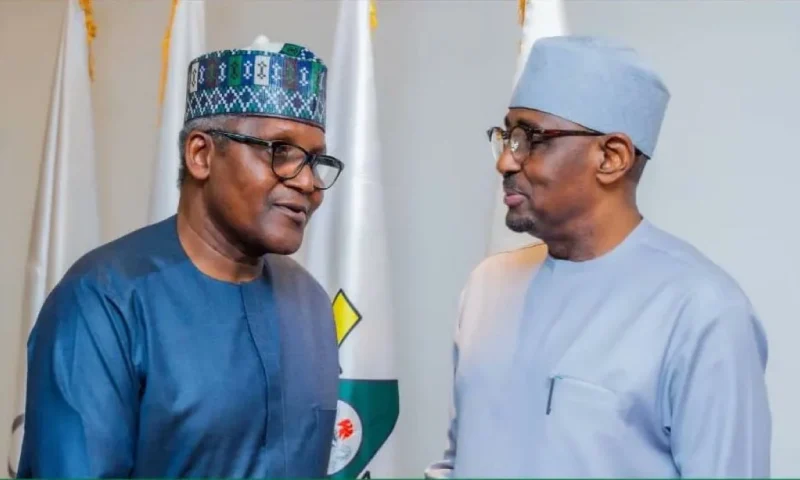
This comes two days after the refinery slashed its petrol gantry price from N828 to N699 per litre. Speaking at a press briefing at the Lekki refinery on Sunday, the President of the Dangote Group, Alhaji Aliko Dangote, said he was aware that despite lower gantry prices, some filling stations often choose to keep pump prices high, thereby sabotaging his efforts.

According to him, MRS would commence the sale of petrol at N739 per litre from Tuesday, while other partners would follow. Dangote alleged that some officials had met with certain marketers and encouraged them to keep prices high in order to frustrate the price reduction, stressing that he would fight to enforce the new price regime.

“I was told that the marketers have met with (some officials) and were told to make sure that the price is maintained high. But this price we are going to introduce, we are going to start with MRS stations most likely on Tuesday in Lagos; that N970 per litre, you won’t see it again. We have also asked members of IPMAN to come now.

We have asked anybody who can buy 10 trucks to come and buy 10 trucks at N699.

“We are going to use whatever resources that we have to make sure that we crash the price down. We will get these sales; maybe it will take us a week to 10 days. But first of all, within a week to 10 days, we will be able to deliver. For this December and January, we don’t want people to sell petrol for more than N740 nationwide. Those who want to keep the price to sabotage the government, we will fight as much as we can to make sure that these prices are down. That’s not the price. If you have money to come and buy, you can pick up petrol at N699,” he said.

Dangote said transporting petrol from the refinery costs no more than N15 per litre, questioning why pump prices would rise as high as N900 per litre. He also accused the Nigerian Midstream and Downstream Petroleum Regulatory Authority of issuing 47 import licences to bring in more than seven billion litres of petrol in the first quarter of 2026, a move he said was killing local investments.

“Freight within Lagos is N10 or N15, maximum. So if it’s N10 to N15, everything is going to cost you N715. Why do you want to sell at N900? People should get the real price. I cannot come now and take the hit. Did we make money? No, we didn’t make money. But as we speak now, even our tanks are full because the NMDPRA has issued reckless licences. And we have to now go and complain to the government.

“They normally issue licences in the middle of the month. So, they are now ready to issue licences for about 7.5 billion litres for the first quarter of 2026, despite the fact that we have guaranteed to supply enough quantity.

“If you are talking about monopoly, did we stop anybody? They issued 47 licences. Let those people come and put up a refinery here, or let them go and buy even NNPC’s and operate them. If it’s profitable, they should go and do that now. NNPC was the only business that was bringing in fuel before.

“Now, we are the only one and one of the few modular refineries that are producing. Those modular refineries, I can tell you for nothing that they are almost on the verge of collapse. None of them is making a dime,” he added.

The billionaire businessman assured Nigerians that the N739 per litre price would be enforced, beginning with MRS stations on Tuesday. “Starting from Tuesday, MRS will start selling petrol at N739/litre. Definitely, we will enforce that low price. We will make sure that it’s implemented. If you have your truck, you can come here and buy it. We are selling at N699. The N699 includes the percentage of NMDPRA. So what actually comes out to us is about N389 or so,” he stated.

Contacted for his reaction, the NMDPRA spokesman, George Ene-Ita, said, “For now, no comment.”

Okpebholo urges Osun APC members to unite ahead of 2026 governorship poll

Edo State Governor and Chairman of the All Progressives Congress, APC, Primary Election Committee, Monday Okpebholo, has urged party members in Osun State to close ranks and work collectively toward winning back the state in the 2026 governorship election.

Okpebholo made the call on Friday night during a stakeholders’ meeting at the APC secretariat in Osogbo, where he said the gathering emphasised the party’s commitment to internal democracy ahead of Saturday’s primary election.

He announced that the party would adopt the affirmation method for the primary, noting that all 1,660 delegates would undergo proper accreditation before being allowed into the venue.

Appealing for calm and cohesion, Okpebholo warned against post-primary divisions, stressing that unity would be critical to the party’s success in the general election.

“I appeal to everyone to remain united after the primary. Do not allow internal grievances to weaken our chances.

“Our collective goal is to return Osun State to the progressive family in 2026, and that can only be achieved if we work together,” he said.

The governor also assured party members that the primary election would be conducted transparently and fairly, in strict compliance with the directive of the APC National Working Committee, NWC.

2027: Tinubu’s re-election should be top priority for APC – Aiyedatiwa

Ondo State Governor, Lucky Aiyedatiwa, has said securing President Bola Tinubu’s re-election in 2027 must remain a shared objective for members of the All Progressives Congress, APC, across the state.

The governor made this known while addressing party leaders at the APC’s quarterly stakeholders’ meeting, where he urged members to close ranks as political activities gradually intensify ahead of future elections.

Aiyedatiwa stressed the importance of unity within the party, cautioning against internal divisions driven by personal ambitions or conflicting interests.

“We must collectively work to deliver Ondo State for President Tinubu in 2027,” the governor said, adding that party cohesion is essential to achieving that goal.

He warned members against actions that could undermine party leadership or fellow party members, even while supporting preferred aspirants, noting that internal discord could weaken the APC’s electoral chances.

The governor explained that the quarterly stakeholders’ meeting was designed to enhance engagement, feedback and collaboration within the party, as well as to review political and developmental progress in the state.

Highlighting achievements of his administration, Aiyedatiwa said efforts had been intensified in the health sector, with several facilities undergoing renovation and standby ambulances being provided across local government areas.

He added that ongoing development projects were deliberately spread across all local councils to promote balanced growth statewide.

The governor also disclosed that the Federal Government had approved the revalidation of Ondo State’s deep seaport licence, explaining that the earlier registration contained errors that failed to properly reflect the state’s identity.

Earlier, the APC Chairman in Ondo State, Ade Adetimehin, who was represented by the party’s Vice Chairman, Atili Agabra, said the meeting provided an avenue for party members to directly engage with the governor.

He commended the state government for employing youths across various ministries, departments and agencies, describing the administration’s engagement with different party organs as unprecedented.

Also speaking, the APC National Vice Chairman (South-West), Isaac Kekemeke, reaffirmed that Aiyedatiwa remains the party’s leader in Ondo State.

While acknowledging the presence of other influential party figures, Kekemeke said the governor is the principal mobiliser for President Tinubu’s second-term ambition in the state.

He added that the President has confidence in APC governors nationwide, describing Aiyedatiwa as a strong loyalist and key campaign figure for Tinubu in Ondo.

Kekemeke observed that most criticisms of the government were coming from within the party, noting that opposition parties such as the Peoples Democratic Party, PDP, and Labour Party no longer pose significant threats in the state.

He urged the governor to continue accommodating diverse interests within the APC and to lead efforts to maintain unity ahead of future political contests.

Changing service chiefs now enough to end insecurity – NLC

The Nigerian Labour Congress, NLC, has told the Federal Government that fighting insecurity is not all about changing service chiefs, stressing that Nigerians need to see results.

President of the NLC, Joe Ajaero, stated this on Friday while responding to questions in an interview on Arise Television monitored

DAILY POST reports that the NLC has declared nationwide protest on December 17th over the wave of insecurity confronting the country.

“The Federal Government changing service chiefs and rejigging the security apparatus doesn’t mean we are seeing results. We need solutions.

“I think we should be real in discussing issues like this. That Minister has been removed, that the Chief of Army staff has been removed does not mean that we don’t have incidences of kidnap and banditry and all manner of things.

“We prefer to have solution to all those problems, and even change of guards, a theoretical pace. We want to see results,” he said.

When asked what options in terms of recommendations the NLC was putting on the table, Ajaero said,  “The NLC has stopped putting the options on the pages of newspaper.

“We wrote to Mr President since June to provide options on tax session, on strike in the tertiary institution, on strike in the education sector and other areas.

“And up to now, no acknowledgement of the letters. So where are we going to put our demand on if it’s not on the table?”

Alleged  $1m Theft: Ex-P-Square Manager,  Jude Okoye’s Wife Owns 800,000 Shares In Company-Witness

The first prosecution witness (PW1), Peter Obumuneme Okoye, in the ongoing trial of Jude Chigozie Okoye, an elder brother and former manager of Paul and Peter Okoye, has told Justice Rahman Oshodi of the  Lagos State High Court, Ikeja, that the defendant’s wife owns 800,000 shares in  Northside Music Limited.


Okoye, alongside his company, Northside Music Limited, is being prosecuted by the Lagos Zonal Directorate 1 of the Economic and Financial Crimes Commission, EFCC, on a four-count charge bordering on theft to the tune of over $1m.


He pleaded not guilty to the charges when they were read to him.


At the resumed trial of the matter  on Friday, December 12, 2025,  defence counsel, Clement Onwuenwunor (SAN) confronted the witness with the statements of account belonging to Northside Music Limited, detailing some transactions over a period of time


The PW1, however, stated the bank statements belonged to their joint business interest, saying, “These statements of account belong to me and my brother. We are P-Square. The company belongs to Peter and Paul. It was registered by him. I reported to the EFCC when I discovered funds were being diverted, and EFCC brought the matter to court”.


“My lord, we own an entertainment company together, and I discovered another company, Northside Entertainment Company diverting our funds. I showed it to my brother.”


He also confirmed that he petitioned the EFCC through his lawyer, and that the defendant’s wife owns 800,000 shares in the company in question.


The defence counsel, thereafter, sought to tender documents attached to the original petition submitted to the EFCC, insisting the documents were vital to their case.


However, the prosecution counsel M. K. Bashir, objected to their admissibility, arguing that “the documents are public documents.


“The defence merely produced copies stamped as Certified True Copies (CTC). They  were not attached to the petition, and they were not in proper legal form.”   He, therefore, urged the court to reject them.


In a short ruling, Justice Oshodi ruled that although the documents originated from the Corporate Affairs Commission (CAC) and ended in the EFCC’s custody, they did not meet the admissibility requirements of the court.


“I reject the documents and mark them as rejected,” the judge held.


The PW1 also confirmed that he wrote a statement at the EFCC after the petition was submitted by his lawyer.


The case was adjourned till February 20 and 27, 2026 for continuation of trial.


FG’s delayed payments threaten Tuesday Reps session

The Reps Green ChamberUncertainty has surrounded the House of Representatives’ plenary scheduled for Tuesday, December 16, 2025, following the Federal Government’s failure to meet its contractual obligations to local contractors who executed projects under the 2024 and 2025 budget cycles.

This comes a week after the Green Chamber held a closed-door session with the Minister of Finance, Wale Edun; the Minister of Budget and National Planning, Atiku Bagudu; the Accountant-General of the Federation, Shamseldeen Ogunjimi; and the Executive Chairman of the Federal Inland Revenue Service, Zacch Adedeji, during which lawmakers criticised the implementation of the capital components of the two budgets.

Over the past two months, local contractors have staged peaceful demonstrations at the National Assembly Complex, demanding payment for completed projects. Despite the House leadership setting up an intervention committee, the stalemate persists.

On December 9, the House resolved that it would not consider the 2026 Appropriation Bill once transmitted by President Bola Tinubu until the Federal Government clears all outstanding debts owed to the contractors. The lawmakers also stepped down consideration of 42 bills slated for first, second, and third readings

Four committee reports on bills proposing agricultural colleges and specialised institutions in Kaduna, Edo, and other states were likewise deferred.

The planned consideration of the constitution review report submitted two weeks earlier was also suspended.

In what appeared to be a last-minute attempt to avert a legislative standoff, Ogunjimi pledged to clear the outstanding payments within 48 hours. However, the deadline elapsed on Friday without contractors receiving any payment—an outcome that could significantly shape Tuesday’s plenary.

Speaking with Saturday PUNCH, a member representing Orhionmwon/Uhunmwode Federal Constituency of Edo State, Billy Osawaru, expressed disappointment that the pledge was not fulfilled but noted that lawmakers were still expecting action from the executive.

“Promise made has not been met, but we are continuing our engagement with the executive arm,” Osawaru said.

Asked whether the House would make good its threat to halt consideration of the 2026 Appropriation Bill, Osawaru said the situation remained unpredictable.

“I am not sure what the outcome will be since we are still expecting the Accountant-General to act,” he added.

Similarly, Mansur Soro, who represents Darazo/Ganjuwa Federal Constituency in Bauchi State, confirmed that contractors were yet to be paid.

“The pledge has not been kept,” Soro stated, adding that, “further engagement between House and executive should be confirmed by the House spokesman or its leadership.”

Efforts to obtain an official position from the House through its spokespersons, Akin Rotimi and Philip Agbese, were unsuccessful, as both lawmakers did not respond to inquiries.

The Federal Government’s delayed payment to local contractors traces back to persistent budget implementation challenges in the 2024 and 2025 fiscal years.

NYSC adds AI, App development to revamped skill acquisition programme

Director General of the NYSC, Brigadier General Olakunle NafiuThe National Youth Service Corps is set  to overhaulits Skill Acquisition and Entrepreneurship Development training for corps members through the standardisation of its curriculum to achieve deeper impact.

In a post via its official X handle on Saturday, the NYSC said its Director-General, Brigadier General Olakunle Nafiu, disclosed this in his address at the 2025 second SAED stakeholders’ summit held in Abuja on Friday.

Nafiu said the scheme had embarked on a comprehensive digital transformation of the SAED programme as a pathway to combating youth unemployment.

The NYSC boss noted that the new curriculum now includes skills such as artificial intelligence and mobile application development, among others.

He further disclosed that corps members were being mainstreamed into the Federal Government’s 3 Million Technical Talent (3MTT) programme, as well as global remote work opportunities through initiatives such as Outsource to Nigeria, NYSC Jobs.ng and the SAED SME Toolkit.

Describing SAED as a pillar of youth empowerment in Nigeria, Nafiu said more than 3.18 million corps members had completed entrepreneurship and workplace readiness training since 2012, with over 30,000 businesses formally registered with the Corporate Affairs Commission (CAC).

“They are employing others and contributing to the Gross Domestic Product, while demonstrating that our youths are capable change agents,” he added.

The DG stressed the need to focus more on competence, mastery of SAED skills and digital fluency among corps members to make them highly competitive in a rapidly changing world.

He described the recently launched ₦2 billion MSME loan fund for corps entrepreneurs, established in partnership with the Bank of Industry (BoI), as a landmark achievement in the drive for entrepreneurship development.

Nafiu also hailed the founding fathers of the NYSC for their foresight in anticipating and laying the foundation for entrepreneurial training, as captured in one of the objectives of the scheme.

“The unemployment rate in 1973 was put at 1.9 per cent, but today it is about 6.9 per cent. Nigeria has many young people who lack employability skills.

“We thank our partners and stakeholders in the SAED programme for collaborating with the NYSC to mitigate the scourge of youth unemployment in Nigeria.

“We must remain committed to empowering a generation whose innovation and enterprise will shape the country’s future prosperity.

“Equipping our young people is not just a programme; it is a national assignment, and the NYSC is fully committed to it,” he said.

He urged participants at the meeting to renew strategies for equipping corps members with the necessary skills, creativity and confidence to thrive in the contemporary world.

Earlier, the Director of SAED, Mr Kehinde Aremu-Cole, expressed gratitude to stakeholders at the summit for driving transformation across multiple sectors, including technology and digital skills, creative industries, entrepreneurship development, financial empowerment nd agricultural revitalisation.

Aremu-Cole described as laudable the trainings, grants and mentorship sessions previously delivered, noting that they were shaping Nigeria’s future through corps members.

He called on stakeholders to create special-purpose funding pathways that would turn desire and skills into productive enterprises.

“Together, we are not just running a programme; we are building a generation.

“Let us keep empowering, and let us keep believing in the potential of our young people,” he said.

Nigeria’s Gas Commercialisation Initiative Targets Scores Of Job Opportunities 

Over 100,000 direct and indirect job opportunities are available from the Nigerian Gas Flare Commercialisation Programme following permits granted to 42 companies under the Access Flare Gas initiative.

The Chief Executive of the Nigerian Upstream Petroleum Regulatory Commission, Gbenga Komolafe, disclosed this during the Permit to Access Flare Gas ceremony for the 2022 NGFCP cycle on Friday in Abuja.

Komolafe said the initiative would also produce about 170,000 metric tonnes of liquefied petroleum gas annually, providing clean energy for roughly 1.4 million households, while unlocking nearly 3 gigawatts of power generation capacity.

He explained that 49 flare sites were auctioned, with 42 successful bidders now set to capture and commercialise between 250 and 300 million standard cubic feet of gas per day currently being flared.

“A total of 49 flare sites have been auctioned. Forty-two bidders have been awarded the sites. Between 250 and 300 million standard cubic feet of currently flared gas will be captured and commercialised, eliminating approximately six million tonnes of carbon dioxide (CO2) annually,” Komolafe said.

He added, “The programme is expected to attract up to US$2bn in investment. More than 100,000 direct and indirect jobs will be created. About 170,000 metric tonnes of LPG will be produced annually, enabling clean energy access for approximately 1.4 million households. And nearly 3GW of power generation potential will be unlocked.”

Komolafe further revealed that an NGFCP Forum and College of Awardees has been established to support implementation and knowledge exchange.

“An NGFCP Forum and College of Awardees has been established to support project implementation and knowledge exchange. We have also deepened engagement with international financiers and technology partners. Furthermore, Nigeria’s leadership in practical upstream decarbonisation continues to gain global recognition,” he said.

He, however, stressed that the permits marked only a step in the process, warning that the success of the programme depended on sustained project execution.

“Let me emphasize that the Permit to Access Flare Gas is a critical step forward, but it is not the final destination. The value of this programme will be realized only through consistent, disciplined project execution. The Commission will closely monitor progress and performance under the Milestone Development Agreements while providing needed regulatory support required for success.

“So to our producers, we appreciate your cooperation and look forward to your continued collaboration, especially during this implementation phase. To our awardees, we look forward to seeing your projects progress from plans to productive assets. Together, we will continue to advance Nigeria’s upstream petroleum sector toward greater transparency, efficiency, sustainability, and global competitiveness.”

The Nigerian Gas Flare Commercialisation Programme was launched by the Federal Government to tackle the long-standing challenge of gas flaring in the country’s oil-producing areas.

Haelsoft Digital among Nigeria’s 100 fastest-growing SMEs

WhatsApp Image 2025-12-13 at 12.43.06 AMHaelsoft Digital Limited has been named one of Nigeria’s Top 100 Fastest Growing SMEs for 2025 by BusinessDay, spotlighting the company’s rapid expansion in digital services and technology training.

Founder and CEO Michael Onyeka Ezeadichie, who also launched Inside Haelsoft and Haelsoft EdTech, has spent over a decade delivering software development, digital consulting, and online education solutions. Ezeadichie said the company’s growth stems from identifying gaps in digital skills and readiness.

“We began as a digital services company,” he said, “but the market quickly showed that the bigger gap was in skills, structures, and digital readiness. Our growth has largely come from responding to those gaps.”

Haelsoft’s EdTech arm now offers courses in software development, cybersecurity, UI/UX design, digital marketing, and data science, addressing rising employer demand for practical digital competence.

In 2025, the firm partnered with Heligande to provide advisory support to family-owned businesses, focusing on digital adoption, operational restructuring, and strategy execution.

“Many companies recognize the need to transform,” Ezeadichie said, “but the real challenge is knowing where to begin and how to sustain the process. That is where our work with Heligande became important.”

Receiving the BusinessDay award on December 4, 2025, Ezeadichie described it as a benchmark rather than a celebration.

“For us, the award is simply data, it tells us we are moving in the right direction, but it also tells us how much more work is ahead,” he said.

Haelsoft’s recognition highlights the growing role of technology-driven SMEs in Nigeria’s digital economy and the impact of founders with strong technical backgrounds in driving growth.


FG approves N6.4tn PPP projects to boost ports, power

Infrastructure Concession Regulatory CommissionThe Federal Executive Council has approved three major Public-Private Partnership projects valued at over N6.43tn, signaling another significant wave of private-sector investment into Nigeria’s infrastructure landscape.

The projects — two deep seaports and a 460-megawatt hydropower plant — form the second batch of PPP initiatives cleared by the Council within one month, underscoring President Bola Tinubu’s push for private capital as a driver of growth under the Renewed Hope Agenda.

The approvals were announced in a statement released by the Director-General of the Infrastructure Concession Regulatory Commission, Jobson Ewalefoh, on Friday.

He said the deals represent one of the strongest signals yet that the government’s reform agenda is yielding measurable impact

The statement read, “The Federal Executive Council has approved three transformative Public-Private Partnership (PPP) projects, confirming an injection of over N6.43tn (approximately $4.29bn) in private capital into the Nigerian economy. These approvals underscore the practical impact of President Bola Ahmed Tinubu’s Renewed Hope Agenda, which prioritises private-sector-led infrastructure delivery as a catalyst for national growth, economic competitiveness, and job creation.”

He explained that improved policy clarity, economic liberalisation, and strengthened regulatory institutions have boosted investor confidence, enabling the Federal Government to unlock billions of dollars in long-term investments.

The newly approved projects constitute the second batch of seven PPP initiatives endorsed by the Council in the last month, all under the regulatory guidance of the Infrastructure Concession Regulatory Commission.

The new projects include the $2.27bn Bakassi Deep Seaport, the $1.14bn Port of Ondo Deep Seaport, and the $878.1m Katsina-Ala Hydropower Plant, all to be fully financed, developed, and operated by private investors.

Ewalefoh said the projects reaffirm the Tinubu administration’s resolve to deploy PPPs to accelerate economic competitiveness, enhance trade, and expand Nigeria’s renewable-energy footprint.

He explained that the Bakassi Deep Seaport, a greenfield development, would create a new maritime gateway for the North-Central and North-East and serve as a major hub for West and Central Africa.

“These are decisive, multi-sectoral investment portfolios that directly address national needs. The approval of the two deep-seaport projects alone, totalling over $3.4bn in private capital, will fundamentally optimise our maritime trade routes and decongest existing port facilities.

“The Bakassi Deep Seaport is a greenfield development designed to accommodate larger vessels and integrate an industrial cluster and Free Trade Zone, creating thousands of jobs and positioning Nigeria as a first-choice maritime destination.

“The approval of the two deep-seaport projects alone, totalling over $3.4bn, will fundamentally optimise our maritime trade routes and decongest existing port facilities,” he said.

He added that the Port of Ondo Deep Seaport is expected to open up the South-West’s solid minerals and agro-allied value chains while positioning Ondo State as a new logistics and export corridor.

On the hydropower project, he said, “The 460MW Katsina-Ala Hydropower Plant is a monumental greenfield project that will help address Nigeria’s persistent electricity deficit while unlocking vast renewable-energy potential.

“This $878 million investment will supply essential base-load power to the national grid and stimulate immense economic activity across the region. It is a strategic commitment to a cleaner, more reliable, and more sustainable energy future for our country.”

The latest approvals follow the clearance of three PPP projects earlier in November — the Product Authentication and Tracking System, the V-PASS contactless biometric verification platform, and the Port Harcourt International Airport concession — which attracted an additional $230.9m in private capital.

With the approvals announced on Thursday, the total number of PPP projects endorsed in 2025 has now exceeded 13, spanning maritime, health, aviation, power, and industrial sectors.

Other PPP projects approved this year include the MediPool initiative under the Health Ministry; the Maritime Electronic Management System of NIMASA; the Ikere Gorge 6MW Hydropower Plant; the Borokiri Coastal Fisheries Terminal; the Farin Ruwa 20MW Hydropower Project; and the concession for Enugu International Airport.

Ewalefoh commended President Tinubu for what he described as “consistent support” for the ICRC, noting that the President’s push to strengthen regulatory institutions has repositioned the Commission as the engine room for PPP development.

“These consistent approvals reflect Mr President’s trust in the ICRC’s mandate and further empower us to deliver even greater value to the nation,” he said.

Nigeria has increasingly turned to PPPs to expand its ageing infrastructure stock amid tight public revenues and rising fiscal pressures. The model allows private investors to finance, build, and operate major assets — particularly in ports, airports, and power — with returns tied to user fees or long-term concessions.

The strategy is crucial for Nigeria’s growth trajectory, with the country requiring an estimated $100bn annually in infrastructure spending to close its deficit.

It also confirms the administration’s intent to shift heavy infrastructure financing to the private sector while improving regulatory oversight to attract long-term capital.