
Nigeria’s capital importation surges 84% to $10.37bn – NBS

Nigeria’s capital importation surges 84% to $10.37bn – NBSNigeria attracted $10.37bn in capital importation in the first quarter of 2026, representing an 83.83 per cent increase from the $5.64bn recorded in the corresponding period of 2025, according to the National Bureau of Statistics.

The latest Capital Importation Report released by the bureau on Wednesday also showed that capital inflows rose by 60.97 per cent from $6.44bn recorded in the fourth quarter of 2025, reflecting renewed foreign investor interest in the country’s financial markets.

The report stated, “In Q1 2026, total capital importation into Nigeria stood at $10.37bn, higher than $5.64bn recorded in Q1 2025, indicating an increase of 83.83 per cent. In comparison to the preceding quarter, capital importation increased by 60.97 per cent from $6.44bn in Q4 2025.”

Analysis of the inflows showed that portfolio investment remained the dominant source of foreign capital, accounting for $9.86bn or 95.09 per cent of the total amount imported into the economy.

The NBS disclosed that foreign direct investment stood at $135.08m, representing only 1.30 per cent of total capital inflows, while other investments accounted for $374.48m or 3.61 per cent.

“Portfolio Investment ranked top with $9.86bn, accounting for 95.09 per cent, followed by Other Investment with $374.48m, accounting for 3.61 per cent. Foreign Direct Investment recorded the least with $135.08m, representing 1.30 per cent of total capital importation in Q1 2026,” the report added.

A further breakdown showed that money market instruments attracted the largest share of portfolio investments at $6.50bn, while investments in bonds amounted to $3.23bn. Equity investments under the portfolio category stood at $131.81m.

The banking sector emerged as the biggest destination for foreign capital during the quarter, attracting $7.55bn, representing 72.79 per cent of total inflows.

The financing sector followed with $2.43bn or 23.42 per cent, while the production and manufacturing sector attracted $152.27m, accounting for 1.47 per cent of total capital imported.

According to the report, “The Banking sector recorded the highest inflow with $7.55bn, representing 72.79 per cent of total capital imported in Q1 2026, followed by the Financing sector, valued at $2.43bn (23.42 per cent), and the Production/Manufacturing sector with $152.27m (1.47 per cent).”

Other sectors that received foreign investments included shares, trading, agriculture, information technology services, telecommunications, oil and gas, transport, construction, healthcare, education, and consultancy services.

The United Kingdom remained Nigeria’s largest source of foreign capital, accounting for $5.08bn or 49.01 per cent of total inflows. The United States followed with $3.18bn, representing 30.69 per cent, while South Africa accounted for $983.83m or 9.49 per cent.

The NBS said, “Capital importation during the reference period originated largely from the United Kingdom with $5.08bn, representing 49.01 per cent of the total capital imported. This was followed by the United States with $3.18bn (30.69 per cent) and the Republic of South Africa with $983.83m (9.49 per cent).”

Among financial institutions, Standard Chartered Bank Nigeria Limited received the highest capital inflow during the quarter at $4.41bn, representing 42.56 per cent of the total.

Stanbic IBTC Bank Plc followed with $2.78bn or 26.79 per cent, while Rand Merchant Bank handled $930.82m, accounting for 8.97 per cent. Other banks that facilitated capital inflows into the country during the period included Citibank Nigeria, Access Bank, First Bank of Nigeria, Guaranty Trust Bank, Zenith Bank, FCMB, Ecobank, Fidelity Bank, and United Bank for Africa.

The report noted that the capital importation data was compiled from information supplied by the Central Bank of Nigeria and captured fresh foreign capital reported by commercial banks. It added that the figures did not include other components of foreign direct investment, such as reinvested earnings.

Africa can raise $469bn without tax hikes – AfDB

Africa can raise $469bn without tax hikes – AfDBAfrica can unlock more than $469bn in additional annual revenue without raising statutory tax rates, according to the African Development Bank.

Chief Economist and Vice President for Economic Governance and Knowledge Management at the African Development Bank, Prof Kevin Urama, said this in an interview with the News Agency of Nigeria on Wednesday in Abuja.

He said the additional revenue could be mobilised without increasing tax rates, stressing that stronger domestic resource mobilisation remained the most sustainable source of development financing for the continent.

According to him, improving tax administration through digitalisation, strengthening public institutions, and enhancing service delivery would significantly increase tax compliance.

“We see that by improving tax administration through digitisation and other reforms, just adopting best practices, the continent can mobilise more than $469bn extra without increasing tax rates.

It is simply about improving efficiency and strengthening compliance,” he said.

Urama said many citizens were reluctant to pay taxes because they often had to provide essential services such as electricity, water, and road infrastructure for themselves.

He noted that governments could improve voluntary tax compliance by delivering quality public services, strengthening transparency, and ensuring prudent management of public resources.

The economist said AfDB was supporting African countries, including Nigeria, to strengthen domestic revenue mobilisation through capacity building for national revenue authorities.

Court Jails  One  for N2.9m  Crypto Fraud in Maiduguri 


Justice Aisha Kumaliya of the Borno State High Court sitting in Maiduguri, on Wednesday, June 3, 2026 convicted and sentenced one Bukar Ahmed Shuwa to ten years imprisonment.


The convict was arraigned on Wednesday, June 3, 2026 by the Maiduguri Zonal Directorate of the Economic and Financial Crimes Commission, EFCC, on a one -count amended charge for the offence of cheating to the tune of N2,950,000.00 (Two Million, Nine Hundred and Fifty Thousand Naira).


The charge reads: “That you, Bukar Ahmed Shuwa sometimes in the year 2024 at Maiduguri, Borno State within the jurisdiction of this honourable court fraudulently induced one Mahmud Ali to deliver to you the aggregate sum of N2, 950,000.00 under the guise of Crypto Bitget Wallet Coin Investment and thereby committed an offence contrary to Section 309 and punishable under Section 310 of the Penal Code Law and Other Matters Connected therewith Law, 2023.”


The defendant pleaded ‘guilty’ to the charge when it was read to him.


Following his plea, prosecution counsel, A.D Abdulmalik prayed the court to convict him accordingly. While in the same vein, counsel to the defendant, H. Basharu pleaded for leniency and urged the court to temper justice with mercy upon him.


Basharu further stated that the convict had fully restituted the money to the petitioner and urged the court to sentence him with an option of fine.


Thereafter, Justice Kumaliya convicted and sentenced the convict to ten years imprisonment with an option of N200, 000 (Two Hundred Thousand Naira) fine.

The convict’s journey to the Correctional facility started when he fraudulently induced the petitioner  to deliver to him the sum of N2.9m under the guise of Crypto Bitget Wallet Coin Investment and diverted the money to his personal use.

Osun guber: REC urges media to combat election misinformation

The Independent National Electoral Commission, INEC, has called on media practitioners in Osun State to support efforts to curb the spread of fake news ahead of the August 15 governorship election.

The appeal was made on Tuesday in Osogbo by the Osun State Resident Electoral Commissioner, Mrs Oluwatoyin Babalola, during a programme titled “The Journalists-INEC Voter Education and Publicity Dialogue on the 2026 Osun State Governorship Election.”

The event was organised by the European Union Support to Democratic Governance in Nigeria programme in collaboration with the INEC headquarters as part of preparations for the forthcoming poll.

Addressing journalists and media stakeholders, Babalola stressed the importance of the media in safeguarding the credibility of the electoral process through accurate and responsible reporting.

She said the media remained a critical partner in voter education, information dissemination and public enlightenment, particularly as the election date draws nearer.

Babalola warned that misinformation and disinformation posed significant threats to credible elections in the digital era, noting that false narratives and manipulated content could erode public confidence in the democratic process.

“As we move closer to this important date, the role of the media as a partner in voter education, information dissemination, and public enlightenment cannot be over-emphasised,” she said.

She added, “One of the greatest threats to credible elections in this digital age is the spread of disinformation and misinformation. False narratives, fake results, doctored videos, and malicious propaganda have the capacity to undermine public confidence in the electoral process, incite violence, and delegitimise outcomes.”

The REC urged journalists to verify information before publication and actively challenge false reports with factual and balanced coverage.

“We must therefore work together to build a robust defence against these threats. The media must serve as gatekeepers of truth, verifying information before dissemination and countering falsehoods with factual reporting,” Babalola stated.

She also reaffirmed INEC’s commitment to providing timely, accurate and verifiable information through its official communication channels, urging journalists to rely on those platforms and collaborate with the commission in addressing misleading reports.

According to her, “the dialogue provided an opportunity for INEC and media organisations to develop creative, culturally sensitive and accessible voter education strategies capable of reaching residents in languages and formats they easily understand.”

Earlier, the Executive Director of the Centre for Media and Society, Dr Akin Akingbulu, called on journalists to uphold their responsibility of educating citizens about their roles before, during and after the election while also scrutinising campaign promises and monitoring the commission’s readiness for the poll.

Akingbulu said media practitioners should not remain passive observers, adding that they must “reflect, interrogate, and rank. And your perspectives will reach further than you may expect.”

Why Anambra will vote for Tinubu in 2027 – Soludo

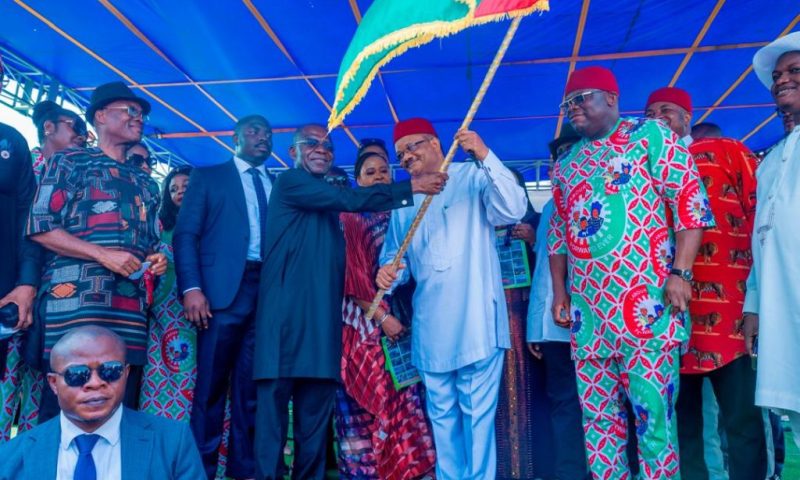
Governor Charles Soludo has said that Anambra State and the All Progressives Grand Alliance would support President Bola Tinubu in the 2027 presidential election.

Soludo made the declaration while addressing members of the City Boy Movement, Anambra State Chapter.

The governor said his political decisions are guided by the interests of Anambra people and the Igbo nation, stressing that he believes in what he described as the “politics of evidence.”

He cited the Federal Government’s approval of the state’s proposed aerotropolis as a Free Economic Trade Zone as an example of the benefits of cooperation with the current administration.

According to him, the approval was granted in what he described as the fastest response he had witnessed from the Federal Government.

Soludo also said that although APGA remains a separate political party, it shares progressive ideals with the ruling party and should work with the Federal Government for the benefit of the South-East region.

The governor maintained that progressive political forces must collaborate to advance the interests of the Igbo people and accelerate development in Anambra State.

Soludo said: “You don’t take second position in politics. I don’t play that kind of politics. The Politics I want to play is for the interest of Ndi Anambra, and the Igbo.

“I only play politics of evidence.

“The President in a fastest approval I have ever seen, he designated our aero metropolis as a free economic trade zone. That’s politics.

“Despite the fact that we are in APGA, we understand it that progressives have to work together for the good of Igbo.”

Kaduna NUT laments kidnapping of students, teachers, tasks govt

The Nigeria Union of Teachers (NUT), Kaduna State branch, on Tuesday staged a nationwide solidarity rally over the abduction of schoolchildren and teachers, calling on the Nigerian government to urgently treat attacks on schools and the abduction of students and teachers as a national emergecy.

Addressing newsmen in Kaduna, Comrade Sunday Garba, the state treasurer of the union, said the protest was driven by the pain of repeated attacks on schools across the country. He said they gathered not by choice but because their children, who are supposed to be the future of Nigeria, are in captivity.

He lamented: “Teachers who are saddled with the responsibility of shaping the future of this country have been silenced.”

Garba explained that the rally was triggered by the recent abduction in Oriire Local Government Area of Oyo State, stressing that it was also a response to a pattern of school kidnappings that remains unabated.

The union observed that in April 2014, 276 female students were kidnapped from Chibok in Borno State and that more than 90 are still missing. It added that in February 2018, 110 schoolgirls were abducted in Dapchi, Yobe State, while five were killed.

The union stated that in December 2020, more than 300 boys were abducted in Kankara, Katsina State, and were later released. It added that in February 2021, 27 students were abducted in Kagara, Niger State, while one student was killed.

The union further stated that in February 2021, 317 girls were abducted in Jangebe, Zamfara State, and later released. It also pointed out that between March and April 2021, 39 students were kidnapped from Afaka in Kaduna State, while about 20 students of Greenfield University were abducted, with five of them later killed by bandits.

“In July 2021, in Chikun Local Government Area of Kaduna State, over 100 students of Bethel Baptist High School were kidnapped and later released in batches. In March 2024, 287 students were abducted in Kuriga, Kaduna State,” he said.

He further recalled that in November 2025, 25 girls were abducted in Maga, Kebbi State, while the vice principal was killed. He also noted that in November 2025, more than 300 students and teachers were abducted from St. Mary’s Catholic School in Papiri, Niger State. In May 2026, 26 children were taken from an orphanage/school in Kogi State, while other abductions occurred in three schools in Oriire, Oyo State.

Garba said that when a child is abducted, every schoolchild loses a piece of their freedom.

“When one teacher falls, every teacher stands afraid. Schools have become targets,” he added.

The union therefore called for the immediate release of all students and teachers in captivity, insisting that the issue should be treated as a national emergency.

Insecurity: We are in trouble, but DSS can do a lot if properly equipped – Ughegbe

Activist and public affairs analyst, Dr. Lemmy Ughegbe, has said the recent arrest of five suspected terrorists, including two foreign nationals, by the Department of State Services (DSS) demonstrates that Nigeria’s security agencies are capable of delivering significant results when adequately equipped and supported.
Ughegbe stated this during an interview on Wednesday on Arise News while discussing the country’s security challenges and the role of citizens in addressing them.

According to him, Nigeria must acknowledge the seriousness of its security situation, noting that even President Bola Tinubu has publicly expressed concern about insecurity.

“We are in trouble as a country; we must admit that,” Ughegbe said.

Despite the challenges, he argued that the DSS operation should inspire confidence in the country’s security institutions.

“This very remarkable feat by the DSS shows that the agency, when allowed to do its job, properly equipped and properly motivated, has the capacity, not just the potential, to generate credible and actionable intelligence,” he said.

Ughegbe said the operation demonstrated the ability of security agencies to infiltrate terrorist networks, intercept intelligence and disrupt the movement of weapons among criminal groups.

“Being able to capture these five terrorists, including two foreign nationals, speaks volumes to the fact that we can be hopeful, even though there is still a lot of work to be done,” he added.

He stressed that intelligence gathering depends heavily on cooperation from members of the public, urging Nigerians to report suspicious activities within their communities.

“DSS officials are not spirits, they will not get information unless citizens provide it. If you have people living within your community whom nobody knows, there should be a way of quietly passing information to the authorities,” he said.

Ughegbe also blamed part of the security challenge on public complacency, saying many residents pay little attention to unfamiliar individuals living around them.

“Many of us live in areas where we do not know our neighbours. Yet terrorists and criminals can live within those same communities,” he said.

The analyst further urged political leaders and opposition figures to avoid politicising security issues, arguing that national security should take precedence over partisan interests.

“If we are all concerned about the state of affairs in Nigeria, then we must put the country first, there cannot be elections without citizens being safe,” he said.

Drawing comparisons with responses to major security incidents in other countries, Ughegbe called for greater unity in tackling insecurity.

“We need to get to a stage where we drop politics and focus on securing our country. Before politics, our citizenship and our safety must come first,” he added.

AfDB flags weak private sector credit in Nigeria

AfDB flags weak private sector credit in NigeriaThe African Development Bank has said banks in Nigeria lend the equivalent of just 9.4 per cent of the country’s Gross Domestic Product to the private sector, reflecting the limited role of the financial system in supporting business growth and economic development.

The bank disclosed this in its African Economic Outlook 2026 report, which noted that Nigeria ranked among the weakest performers among major African economies in private sector credit provision.

According to the report, “Major African economies such as Kenya (31.6 per cent), Egypt (28.3 per cent), Côte d’Ivoire (21.4 per cent), and Nigeria (9.4 per cent) remain well below comparable emerging lower-middle-income market economies such as Vietnam (121.6 per cent), Malaysia (121.5 per cent), and Chile (111.8 per cent).”

The AfDB stated that Africa’s domestic credit to the private sector averaged 34.6 per cent of GDP between 2020 and 2024, the lowest level among global regions and a decline from the previous decade.

It noted that most bank lending across the continent remained concentrated in short-term and low-risk assets rather than long-term investments capable of generating stronger development outcomes.

The report stated, “Low intermediation implies that Africa’s financial institutions are unable to optimally support the development of the private sector and contribute meaningfully to economic growth and development.”

The AfDB attributed the weak credit environment to poor financial intermediation and low domestic savings mobilisation.

It noted that many African countries recorded low deposit-to-GDP ratios, with the continental median standing below 32 per cent. Africa’s gross domestic savings averaged 16.6 per cent of GDP between 2021 and 2024, far below the global average of 27.3 per cent.

According to the report, weak savings mobilisation constrains banks’ ability to extend credit, limits balance-sheet expansion and reduces access to stable, low-cost funding.

The bank also blamed regulatory weaknesses for the limited availability of credit to businesses. It stated that poorly designed or weakly enforced regulations increase compliance costs and uncertainty, thereby discouraging lending to the private sector.

The report added that weak collateral enforcement, slow judicial processes and stringent prudential requirements increase perceived credit risks and encourage financial institutions to focus on low-risk borrowers.

“Countries with strong regulatory frameworks tend to have higher private sector credit as a share of GDP,” the AfDB said.

The lender further observed that commercial banks and other financial institutions across Africa remained major holders of government securities, a trend that reduces resources available for lending to businesses.

In its assessment of Nigeria, the AfDB described the country’s financial system as shallow and said stock market capitalisation averaged just 11.8 per cent of GDP between 2020 and 2024, among the lowest levels in Africa.

The report noted that Nigeria faced significant challenges in mobilising large-scale financing to close its infrastructure gap and sustain critical social spending. It attributed the challenge to weak domestic revenue mobilisation, a large informal economy and a narrow economic base.

The AfDB called for deeper financial market reforms and greater use of financing instruments such as green bonds, public-private partnerships, blended finance and debt-for-development swaps to expand access to long-term capital.

It also urged stronger collaboration with development finance institutions to improve domestic resource mobilisation and deploy resources more effectively.

The report comes amid concerns that elevated interest rates and rising government borrowing have constrained credit to businesses, particularly small and medium-sized enterprises, despite efforts to stimulate private sector-led growth.

A renowned economist and Chief Executive Officer of the Centre for the Promotion of Private Enterprise, Dr Muda Yusuf, earlier warned that rising Federal Government borrowing from the domestic financial system is increasingly crowding out the private sector, as banks favour low-risk, high-yield government securities over lending to businesses.

CBN bets on rules to stabilise FX market

Cardoso. CBNFor years, Nigeria’s foreign exchange market has been shaped as much by uncertainty as by supply and demand. Importers complained about delays and documentation bottlenecks. Exporters often questioned whether existing procedures encouraged them to repatriate earnings through official channels. Investors worried about policy reversals and access to foreign exchange. The banks found themselves navigating changing regulations, multiple directives, and periods of market stress.

Against that backdrop, the launch of the fourth edition of the CBN’s Foreign Exchange Manual represents more than a regulatory update. It is the latest stage in a broader effort by monetary authorities to build a foreign exchange market governed less by discretion and more by clear rules, transparency and accountability.

The revised manual, which became effective on 1 June, comes after nearly eight years since the previous edition was issued in 2018. During that period, Nigeria’s economy experienced a global pandemic, oil price volatility, foreign exchange shortages, exchange rate reforms and a shift towards a more market-driven currency regime. Those developments exposed weaknesses in the existing framework and increased calls for clearer operating standards.

Speaking at the launch, CBN Governor, Mr Olayemi Cardoso, argued that the changes were necessary to align foreign exchange administration with present realities.

“Foreign exchange is more than a financial instrument; it is a critical enabler in any open economy. It anchors price stability, facilitates the flow of goods and capital, and shapes investor sentiment,” Cardoso said.

He noted that both global and domestic economic conditions had changed considerably over the past decade, requiring regulators to update the framework guiding market operations.

“Ongoing foreign exchange market reforms have made it necessary to revise the Manual to provide a more coherent and forward-looking regulatory framework. The last edition was issued in 2018, making this review both timely and necessary,” he added.

Yet beyond the ceremonial launch, the revised manual raises a broader question. Can clearer rules and stronger compliance requirements help deliver the stable, transparent and liquid foreign exchange markets that policymakers have promised for years?

Rules driving confidence

The CBN’s current reform programme has largely focused on restoring confidence in the foreign exchange market. Since assuming office, Cardoso has repeatedly argued that transparency, market discipline and credible price discovery are prerequisites for attracting investments and improving liquidity.

The revised manual appears designed to provide the operational framework for those objectives.

According to the Deputy Governor, Economic Policy Directorate, Dr Muhammad Abdullahi, the review formed part of a wider strategy initiated at the beginning of the current administration of the apex bank.

“It is important to note that the reform and comprehensive review of Nigeria’s Foreign Exchange Manual was initiated by the CBN Governor, Mr Olayemi Cardoso, from the very beginning of his administration as part of a broader agenda to restore confidence, improve transparency, deepen liquidity, and strengthen the overall functioning of Nigeria’s foreign exchange market,” Abdullahi said.

His remarks suggest that the manual should not be viewed in isolation. Rather, it follows a series of reforms introduced over the past two years, including the adoption of the Electronic Foreign Exchange Matching System, the Nigerian Foreign Exchange Code and efforts to unify exchange rate determination within the official market.

Those reforms sought to address longstanding criticisms that Nigeria’s foreign exchange market was fragmented, opaque and vulnerable to discretionary practices.

“A modern FX market cannot thrive in an environment characterised by opacity, fragmentation, delays, uncertainty, or excessive administrative bottlenecks,” Abdullahi said. “It requires trust, transparency, liquidity, efficient market infrastructure, prudent regulation, and responsible market conduct.”

The deputy governor argued that the revised manual would help create those conditions by standardising procedures, clarifying documentation requirements and establishing clearer responsibilities for authorised dealers and market participants.

The objective is not simply regulatory compliance. It is to reduce uncertainty.

Foreign exchange markets function most efficiently when participants understand the rules and have confidence that those rules will be applied consistently. Where ambiguity exists, businesses tend to delay investment decisions, traders demand higher risk premiums, and investors become cautious.

For Nigeria, where foreign exchange remains central to trade, manufacturing, education, healthcare and capital flows, such uncertainty carries significant economic costs.

This explains why the CBN repeatedly emphasised transparency and consistency throughout the launch event.

Cardoso also described the revised manual as part of efforts to strengthen “clarity, consistency, and market efficiency” while promising stronger monitoring mechanisms to ensure accountability across the system.

Whether those goals are achieved will ultimately depend on implementation. Regulations alone rarely change markets. Consistent enforcement does.

What has changed?

The practical significance of the revised manual lies in its detailed operational provisions.

While many of the changes may appear technical, they affect a wide range of economic activities, from import transactions and export proceeds to travel allowances and tuition payments abroad.

Among the notable revisions is the harmonisation of Personal Travel Allowance and Business Travel Allowance disbursements with the revised Bureau de Change guidelines. Under the new arrangement, 75 per cent of PTA and BTA transactions will be processed electronically, while only 25 per cent may be disbursed in cash.

The manual also increases allowable advance payments for imports from 15 per cent to 30 per cent. For businesses that depend on imported inputs, this could improve transaction flexibility and reduce delays associated with supplier payment arrangements.

Another important provision concerns export transactions. Processing of Form NXP, the principal export documentation platform, will now be free of charge. The manual also introduces specific provisions governing service exports, technology-sector remittances and Pan-African Payment and Settlement System transactions.

These additions reflect changes in the structure of Nigeria’s economy.

A growing share of foreign exchange earnings now originates from services, technology exports and regional trade rather than traditional merchandise exports alone. Regulatory frameworks that fail to recognise those realities risk becoming outdated.

The revised manual also introduces Non-Resident Investment Accounts and Non-Resident Ordinary Accounts, while allowing foreign companies operating in the extractive sector to repatriate 100 per cent of export proceeds.

Perhaps more significant for individual account holders is the removal of the mandatory Form A requirement for remittances using ordinary domiciliary accounts.

Although authorised dealer banks will still be required to verify the legitimacy of transactions, the change eliminates an administrative layer that many market participants considered cumbersome.

The manual further provides for tuition fee payments of up to $25,000 per semester for undergraduate and postgraduate studies abroad and allows transfers between export proceeds domiciliary accounts and ordinary domiciliary accounts under specified conditions.

Collectively, these provisions indicate a regulatory approach focused on reducing bottlenecks while maintaining oversight.

“Our goal is to reduce transaction frictions, improve processing timelines, deepen market confidence, encourage formal market participation, and create a more seamless and efficient experience for legitimate users of Nigeria’s foreign exchange market,” Abdullahi said.

For businesses and investors, the real measure of success will be whether these changes translate into faster processing, reduced compliance costs and more predictable access to foreign exchange.

Banks back discipline

Among market participants, commercial banks are likely to play the most critical role in implementing the revised framework.

As intermediaries between customers and the foreign exchange market, banks will be responsible for applying documentation standards, processing transactions and ensuring compliance with the new requirements.

It was therefore notable that bank chief executives used the launch event to publicly endorse the reforms.

Speaking on behalf of the Body of Banks’ Chief Executive Officers, the Group Managing Director of United Bank for Africa, Mr Oliver Alawuba, described the revised manual as a continuation of the CBN’s recent market reforms.

“Coming after the introduction of the Electronic Foreign Exchange Matching System and the Nigerian Foreign Exchange Code, this revised manual reinforces a clear policy direction of the Central Bank of Nigeria, a policy direction that anchors on transparency, ethical conduct, credible foreign exchange discovery, stronger documentation, improved oversight, and greater confidence,” Alawuba said.

He argued that reforms introduced over recent years had altered perceptions within the market.

“One of the things I always ask anytime I ask questions about Nigeria is that two years ago or three years ago, as a banker, if you meet your customer, they will ask you, ‘Do you have foreign exchange for us?’ But today, when you meet your customer, you will be the one asking the customer whether they have foreign exchange,” he said.

His remarks reflected the CBN’s broader objective of encouraging foreign exchange inflows into the formal market rather than outside official channels.

However, Alawuba also stressed that reforms could not succeed without discipline, saying, “We can’t do this reform without discipline. So what this manual comes with is the discipline of operators and regulators and all stakeholders as we continue to have a sustainable foreign exchange market.”

A similar theme emerged in remarks by the Group Managing Director of Access Holdings Plc, Mr Roosevelt Ogbonna.

Alleged impersonation of EFCC Staff: Defendant faces judgment June 15

Justice A. I. Akobi of the Federal Capital Territory, High Court, Kubwa, Abuja, on Monday, June 1, 2026, slated June 15, 2026 for judgment in the case of criminal impersonation of  officers of the Economic and Financial Crimes Commission, EFCC and extortion by one Salifu Olije Mustapha.

At Monday’s proceeding, the EFCC presented its First Prosecution Witness, PW1, Stanley Ujilibo against the defendant.

The witness, an investigator with the EFCC, disclosed that the Commission received intelligence on how the defendant and two others, identified as Haruna Mamuda Adamu and Abubakar Umar Hamisu- who are currently under arrest and investigation by a security agency-on several occasions kitted themselves with fake operational uniforms of EFCC and set out in the defendant’s Toyota Corolla, with registration number KTU-399-GT to extort money from unsuspecting youths around Sherif Plaza, Wuse 2, Abuja.

He further disclosed that the defendant’s share of the proceeds of their criminal activities is usually paid into his account with Moniepoint Microfinance Bank, adding that EFCC’s investigation team had to write Moniepoint for the statement of the defendant’s account as well as his account opening package and certificate of identification.

Documents, including video evidence, recorded by eyewitnesses during one of the gang’s unlawful activities, tendered in evidence by prosecution counsel, R.U. Adagba were admitted by the court and marked Exhibit A to D.

On his part, counsel to the defendant, John Ainetor, prayed the court for a short adjournment to enable him review the evidence and cross-examine the witness.

The defendant is being prosecuted by the EFCC on a four-count charge, bordering on criminal impersonation to which he pleaded guilty upon arraignment.

Justice Akobi adjourned the matter till June 15, 2026 for continuation of cross-examination and sentencing of the defendant.