Stop buying petrol above N739/litre, Dangote tells Nigerians

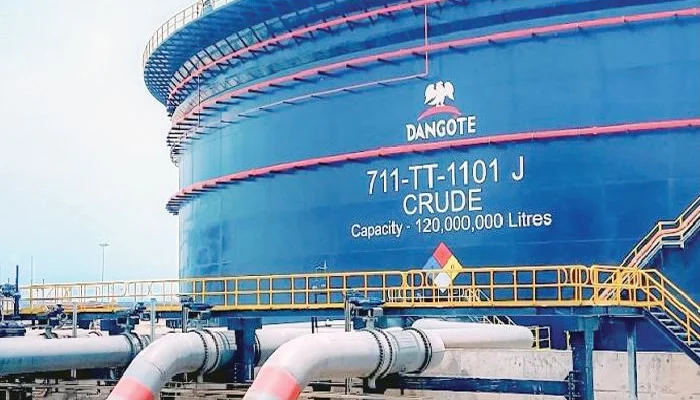
DANGOTE REFINERYDangote Petroleum Refinery has announced the launch of a dedicated hotline for Nigerians to report any MRS Oil Nigeria Plc filling station selling Premium Motor Spirit (petrol) above the approved pump price of N739 per litre.

The firm also warned marketers against creating artificial scarcity, saying the refinery is supplying up to 50 million litres per day.

In a statement on Monday, the refinery said the initiative underscored its commitment to ensuring transparency, affordability, and consumer protection in the downstream petroleum market.

“The hotline number 0800123 5264 is now active nationwide, enabling consumers to promptly report violations and help maintain fair pricing across over 2,000 MRS stations. This measure follows the refinery’s recent commencement of nationwide PMS sales at N739 per litre—a strategic intervention aimed at stabilising fuel prices and easing the financial burden on Nigerians during the festive season,” the statement said.

The Dangote refinery emphasised its mission to deliver affordable, high-quality fuel while safeguarding national economic interests.

“We encourage Nigerians to avoid purchasing PMS at inflated prices when locally refined fuel is available at N739 per litre. Report any MRS station selling above this price by calling our hotline. Together, we can ensure that the benefits of this price reduction reach every consumer,” the statement read.

The refinery also reaffirmed its commitment to steady supply, backed by a guaranteed daily output of 50 million litres, and warned against attempts to create artificial scarcity or manipulate supply, urging regulatory authorities to remain vigilant and take decisive action against unpatriotic practices.

“By refining locally at scale, Dangote Refinery is reducing Nigeria’s dependence on imports, conserving foreign exchange, stabilising the naira, and strengthening energy security. This initiative represents a significant milestone in the country’s journey toward sustainable energy solutions and economic recovery,” it stated.

The refinery also issued a stern warning against attempts by unscrupulous operators to create artificial scarcity in response to the price reduction, calling on government agencies to act decisively.

“Any attempt to create artificial scarcity or manipulate supply to frustrate recent price reductions is unpatriotic and unacceptable. We urge regulatory authorities to remain vigilant and take firm action against such practices, especially during this critical festive period,” the statement added.

Tinubu cautions Nigerians against alcohol, vows to defeat bandits, terrorism

As Nigerians head into 2026, President Bola Tinubu has declared his administration would defeat banditry and terrorism in the country.

This was as Tinubu warned Nigerians against the intake of alcohol and becoming endangered to anybody’s life during the Yuletide season.

Tinubu spoke while receiving organisers of Eyo Festival who paid homage to him at his Lagos residence, ahead of the Eyo Festival scheduled for December 27.

He urged Nigerians to be moderate in their enjoyment during the Yuletide season.

According to Tinubu: “I’m happy for this great cultural remembrance and rekindle of our culture, it’s a great honour to come back home to meet our people happy, healthy for the celebration of Eyo carnival in peace, harmony, love, and brotherhood.

“We continue to pray to God Almighty that the coming Christmas will be a joyous one for everyone of us.

“The coming holidays will not be a disaster for Nigeria, God will bless all of you, you stay in peace, rejoice in peace, dance in peace, no alcohol, no danger to anybody’s life,  and everybody is a member of this great family.

“Eko is progress, Nigeria is making progress and it’s a result of this progress that we are all rejoicing in this period.

“God would bless you, bless Lagos, bless Federal Republic of Nigeria, and I assure you that we will defeat banditry and terrorism.”

Dangote launches N739/litre petrol at MRS stations nationwide

DANGOTE REFINERYDangote Petroleum Refinery has commenced nationwide sales of Premium Motor Spirit (petrol) at a pump price of N739 per litre across all MRS Oil Nigeria Plc filling stations, marking a significant milestone in the refinery’s mission to deliver affordable fuel to Nigerians and stabilise the downstream petroleum market.

In a statement from the firm on Sunday, it stated that with over 2,000 MRS stations nationwide, the new pricing is expected to be implemented across all outlets, ensuring that the benefits of the reduction reach consumers throughout the country. The refinery commended marketers who have embraced the new pricing regime and urged others to follow suit in support of national economic recovery.

“We commend MRS and other marketers who have demonstrated patriotism by reflecting the reduced price at the pump. We call on others to join this effort as a show of support for Nigeria’s economic recovery,” the refinery stated.

Historically, the festive season in Nigeria has been associated with fuel scarcity and sharp price hikes. However, Dangote refinery has intervened decisively—reducing pump prices at a time when Nigerians typically brace for hardship. Backed by a guaranteed daily supply of 50 million litres, this initiative fundamentally alters supply dynamics during the holiday period.

By refining locally at scale, the refinery is reducing Nigeria’s exposure to volatile global markets, conserving foreign exchange, stabilising the naira, and strengthening energy security.

The sustained price cut and steady supply are providing relief to households, businesses, and transport operators nationwide.

The refinery also issued a stern warning against attempts by unscrupulous operators to create artificial scarcity in response to the price reduction, calling on government agencies to act decisively.

“Any attempt to create artificial scarcity or manipulate supply to frustrate recent price reductions is unpatriotic and unacceptable. We urge regulatory authorities to remain vigilant and take firm action against such practices, especially during this critical festive period,” the statement added.

Consumers were advised to resist purchasing fuel at inflated prices when cheaper, high-quality alternatives are readily available.

“We encourage Nigerians to avoid buying PMS at excessively high prices when they can access locally refined fuel at ₦739 per litre from over 2,000 MRS stations nationwide. Report any MRS station selling above ₦739 per litre by calling 0800 123 5264,” the refinery said.

The company also called on other petrol station operators to patronize its products so that the benefits of the price reduction can reach all Nigerians, ensuring broad-based relief and a more stable downstream market.

Dangote Petroleum Refinery reaffirmed its commitment to steady supply, price moderation, and energy security, emphasizing that its operations are anchored on long-term national interest rather than short-term market pressures.

“Our objective remains clear: to ensure a consistent supply of high-quality petroleum products at affordable prices for Nigerians, while supporting economic stability and reducing dependence on imports,” the refinery concluded.

Shareholders push banks as recapitalisation deadline nears

CBN logoWith roughly three months to the end of the expiration of the deadline for recapitalisation in the banking sector, shareholder groups have demanded action from banks that are yet to cross the minimum capital requirement thresholds.

In separate interviews with The PUNCH over the weekend, the leaders in the minority investors community lamented that they would be worst hit if banks fail to meet the new MCRs ahead of schedule.

After the last Monetary Policy Committee meeting of 2025, the governor of the Central Bank of Nigeria, Olayemi Cardoso, disclosed that 16 banks have achieved full compliance with the revised capital requirements, ahead of the deadline.

Cardoso reiterated CBN’s commitment to ensuring an orderly end to the recapitalisation exercise during a presentation at the U.S.-Nigeria Executive Business Roundtable held in Washington, D.C., this week. According to THISDAY, which obtained a copy of the presentation, Cardoso said, “Nigeria is now in the final phase of its most significant banking-sector strengthening effort in over a decade. The recapitalisation programme is designed to safeguard financial stability, expand banks’ capacity to lend, and ensure the financial system is able to underpin Nigeria’s broader economic transformation.

“We’re making good progress. 16 banks have already met or exceeded the new capital thresholds, while 27 have raised capital through public offers, rights issues, private placements, and mergers.”

While hailing the feat achieved thus far and expressing confidence in the ability of the remaining banks to meet the MCR, the minority investors’ community also fears that they would be left holding the short end of the stick if some of the banks don’t meet the threshold.

National Coordinator of the Independent Shareholders Association of Nigeria, Moses Igbrude, said, “The banks’ recapitalisation hurdle so far has been very impressive and encouraging, seeing about 16 banks crossing the hurdle. The most impressive part of it is how investors, especially the Nigerian investors, embraced and keyed in to the various offers that were made to the point of oversubscription. It is a sign that investors, both local and international, have strong confidence and believe in the Nigerian capital market.

“As the deadline comes closer, I have the confidence that the remaining banks are in the various stages of capitalising; after all, there are different banking licences: regional, national and international licences. If you cannot meet the highest category, you go for the lower one.

As for the nationalised banks, the government should recapitalise them through the CBN, which is running them on behalf of the FG. After the recapitalisation process, the FG should privatise them by selling 60 per cent to qualified core investors and the remaining 40 per cent to the Nigerian people to recover the money used to recapitalise them and list the shares on the floor of the NGX.”

To the banks still lagging, Igbrude said, “If there are banks that are not making headway, they should do so now through all available means, both private placement and mergers and acquisitions, or opt for the lowest licence available to avoid revocation of their licences. Let them not say there is still time.  Let them make hay while there’s sunshine.”

The National Coordinator of the Pragmatic Shareholders Association, Bisi Bakare, in her comments, called for speed: “The recapitalisation process is going on well so far, and according to CBN, only 16 banks have concluded their capital raising.  It’s my opinion that as deadlines draw closer, banks should hasten up for merger, strategic realignment or be outrightly acquired by other strong banks rather than waiting for the CBN regulatory hammer, which would not work in their favour nor shareholders’ (investors’).”

The chairman of the Ibadan Zone Shareholders Association, Ayoola Gilbert, called on the CBN to be prepared with clear contingency plans to safeguard the system’s integrity as the recapitalisation deadline gets closer.

“This policy is not just about bigger numbers on the bank’s balance sheet. The CBN has positioned it as a foundational pillar for achieving a $1tn economy by 2030. The core objectives are to create banks strong enough to withstand domestic and global economic shocks while enabling banks to take on larger risks and provide the substantial credit needed to fund critical national projects and support key sectors like MSMEs. If a significant number of banks are still scrambling as of the fourth quarter of 2025, the consequences will ripple through the entire financial ecosystem, directly impacting consumers, shareholder value and systemic trust.

“The successful banks like Access Holdings, Zenith Bank, and Wema Bank, which have raised hundreds of billions, demonstrate that recapitalisation is achievable and can be rewarded by the market. Their strength positions them to lead financing for Nigeria’s growth. As shareholders, we must urge the boards and management of our banks to exhaust every option, be it rights issues, private placements, or strategic mergers, with urgency. Simultaneously, we call on the CBN to communicate a clear, transparent contingency framework well before the deadline. Knowing the rules of a potential orderly consolidation will do more to maintain confidence than a last-minute regulatory scramble.”

Indigenous operators now power Nigeria’s energy future – IPPG

The Independent Petroleum Producers Group has marked its 10th anniversary, celebrating a decade of resilience, collaboration, and transformative impact in Nigeria’s oil and gas industry.


Speaking at the milestone event, the IPPG Chairman and Chief Executive Officer of Aradel Holdings, Mr Adegbite Falade, described the journey as “a decade defined by purpose, partnership, and impact,” according to a statement from IPPG on Sunday.

He said the anniversary was not merely a celebration of longevity, but a reaffirmation of the Group’s shared commitment to strengthening indigenous leadership and advancing Nigeria’s energy sector.

“This anniversary marks a decade in which indigenous operators have demonstrated their capacity to lead, deliver value, and shape the future of Nigeria’s energy sector,” Falade said.

Over the past 10 years, IPPG has evolved into a leading industry voice and a credible partner in sector development.

Through sustained advocacy and collaboration with government and regulators, indigenous operators now account for over 50 per cent of Nigeria’s crude oil and gas production, an achievement widely regarded as evidence of IPPG’s growing influence and effectiveness.

Falade commended the administration of President Bola Tinubu for reforms aimed at repositioning the sector for growth and investment. He also acknowledged the support of the Ministers of State for Petroleum Resources, the Special Adviser to the President on Energy, and the leadership of key institutions, including the Nigerian Upstream Petroleum Regulatory Commission, the Nigerian Midstream and Downstream Petroleum Regulatory Authority, the Nigerian Content Development and Monitoring Board, and the NNPC Limited.

Reflecting on the anniversary theme, “Building on a Decade of Impact,” Falade reaffirmed IPPG’s commitment to supporting government efforts to achieve energy security, particularly in the wake of International Oil Company divestments. He stressed that responsibility now rests squarely on indigenous operators to deliver sustainable production growth.

Representing President Tinubu at the event, the Minister of State for Petroleum Resources (Oil), Senator Heineken Lokpobiri, described IPPG as a critical force in the industry and “one of the best things to have happened to Nigeria’s oil and gas sector.” He also cited the appointment of Mr Ademola Adeyemi-Bero as Nigeria’s OPEC Governor and Chairman of the OPEC Board of Governors for 2025 as global recognition of indigenous capacity.

The celebration featured a high-level fireside chat focused on indigenous leadership and the future of the industry, alongside Leadership Recognition Awards honouring distinguished members and sector leaders.

Looking ahead, IPPG reiterated its resolve to contribute meaningfully to Nigeria’s targets of producing three million barrels of oil per day and 12 billion standard cubic feet of gas by 2030. Over the next five years, the Group said it would prioritise infrastructure expansion, host community engagement in the Niger Delta, capacity building, strong governance, and responsible resource development.

As IPPG enters its second decade, the Group reaffirmed its commitment to act as a catalyst for Nigeria’s economic transformation and industrialisation by harnessing the nation’s vast oil and gas resources to create viable linkages between the industry and the broader economy.

Ondo magistrates threaten strike over poor welfare

courtMagistrates, Presidents of Grade ‘A’ Customary Courts, and Legal Research Officers of the Ondo State Judiciary have threatened to embark on strike action over what they described as prolonged neglect and inadequate support from the state government.

The strike, according to a letter by the Coalition of Magistrates, Presidents of Grade ‘A’ Customary Courts, and Legal Research Officers, is set to commence from January 5, 2026.

In the letter dated December 10 and addressed to the state Chief Judge, the coalition said the government’s failure to ensure judicial autonomy had adversely affected the welfare, operational efficiency, and dignity of office necessary for effective justice delivery across the state.

They argued that repeated appeals and engagements over the years had yielded no meaningful intervention, leaving the working conditions of frontline judicial officers grossly inadequate and misaligned with economic realities.

“While we operate under different jurisdictions and structures within the Judiciary, we are equally frontline officers whose working conditions have, over the years, remained grossly inadequate and misaligned with prevailing economic realities and acceptable judicial standards. Repeated appeals and engagements have not yielded the required interventions, and the situation has now become untenable,” they said.

The judicial officers listed some of their demands, including an increment in the retirement age from 60 to 65 years, an upward review of salaries by at least 500 per cent, placement of Magistrates and Presidents of Grade ‘A’ Customary Courts on Salary Grade Level 17, and provision of official vehicles and mobility support.

They lamented that the continued failure of the state government to provide official vehicles, despite the approval of funds for this purpose over a year ago, had compelled them to operate under conditions that undermine efficiency, dignity, and the effective administration of justice.

The coalition warned that if their demands were not met by January 5, 2026, they would withdraw their services.

Oando organises seminar for law students

Oando PlcOando Plc has convened law students from six Nigerian universities for its 2025 Legal Seminar, a 14-year initiative it described as one of its most consistent capacity-building platforms for emerging legal talent.
In a statement on Friday, Oando said the mentorship-driven forum brought together students from the University of Lagos, Obafemi Awolowo University, Lagos State University, Olabisi Onabanjo University, Rivers State University and Afe Babalola University, with a focus on equipping them with practical, market-relevant insights often absent from traditional legal curricula.

The seminar, themed ‘The 21st Century Lawyer: Keys to Building a Successful Legal Career’, featured contributions from senior practitioners in corporate law, private practice and technology law, with discussions centred on the intersection of law, business and industry.

Opening the session, Oando’s Chief Legal Officer, Efuntomi Akpeneye, said the company deliberately shifted the programme towards mentorship to bridge the gap between academia and commercial practice.

“We started this seminar to share practical knowledge across legal, energy, tax and finance. Today’s shift to mentorship for students is deliberate. Think like a business partner. Let the client’s pain be your pain. That is how you become indispensable,” she said.

Partner at Banwo & Ighodalo, Stella Duru, urged students to prioritise professionalism and discipline as key differentiators in the legal profession. “Law is a lifelong journey of learning and adaptation. Your network, professionalism and dedication will define how far you go,” she added.

Also speaking, Senior Associate at Aluko & Oyebode, Adeleresimi Adeleye, encouraged students to position themselves for a more globalised legal market, adding, “Specialised knowledge is no longer optional. If you want cross-border relevance, your skills, your language capability and your professional identity must reflect that ambition.”

From a corporate perspective, the Managing Director of Oando Energy Resources, Ainojie ‘Alex’ Irune, said legal training provides a strong advantage in commercial environments. “A law background gives you an undue advantage in commercial settings. The world is changing fast; the choices you make now will determine your relevance in the years ahead,” he noted.

The seminar also examined the growing impact of artificial intelligence and digital tools on legal practice. Leading a session on legal technology, Partner at BOC Legal, Rotimi Ogunyemi, said while AI would transform aspects of legal work, human judgement remained critical.

“AI will reshape research and drafting, but it cannot read a room or exercise ethical judgement. Human plus AI will always outperform human alone,” he submitted.

According to the statement, the event ended with a fireside chat involving Oando’s in-house counsel and internal business partners, including the Deputy Manager, Projects, Procurement and Operations, Aniekan Okon; Asset Manager, Oando Energy Resources, Oluwaseyi Fowora; and Non-Oil Commodities Lead, Oando Trading, Olusegun Oyewole. It was moderated by the Legal Advisor, Oando Trading, Isi Abulime.

The company said the seminar reinforced its commitment to talent development by bridging the gap between legal education and professional practice through mentorship, operational exposure and the transfer of institutional knowledge.

CBN pockets N192m from 82 BDC licensees

CBN Governor, Olayemi Cardoso. Photo: CBN / XThe Central Bank of Nigeria may have earned at least N192m in non-refundable fees from the 82 Bureau De Change operators who have just secured final licences under the revised regulatory framework,
The amount is based on the fee schedule in the May 2024 Regulatory and Supervisory Guidelines for Bureaux De Change Operations in Nigeria and the list of approved operators released by the Bank on December 8, 2025.

In a recent press statement, the CBN announced that it had granted final licences to 82 BDCs, effective November 27, 2025. “The Central Bank of Nigeria, in exercise of its powers under the Banks and Other Financial Institutions Act (BOFIA) 2020 and the 2024 Guidelines, has granted final licences to 82 Bureaux De Change to operate with effect from November 27, 2025,” the statement read.

The list shows that two of the firms are Tier 1 operators, while the remaining 80 are Tier 2. The tier assigned to each operator determines the amount it must pay as application and licence fees in addition to its minimum capital requirement.

Section 7.0 of the 2024 guidelines sets the non-refundable application fee for a Tier 1 BDC at N1m and the non-refundable licence fee at N5m. For Tier 2 BDCs, the application fee is N250,000, represented in the document as N0.25m, while the licence fee is N2m.

Using these official figures, the two Tier 1 operators will together pay N12m to the CBN. Their combined application fees amount to N2m, calculated as N1m each for the two operators. Their combined licence fees amount to N10m, made up of N5m each.

For the 80 Tier 2 operators, the combined application fees come to N20m. This is obtained by multiplying the N250,000 application fee by 80, giving N20m. The total licence fees for Tier 2 BDCs amount to N160m, calculated by multiplying N2m by 80.

When the Tier 2 application fees of N20m are added to the Tier 2 licence fees of N160m, the total for that category is N180m. Adding the N12m due from Tier 1 operators to the N180m due from Tier 2 operators gives an overall fee income of N192m for the CBN from this first batch of 82 approvals.

The calculation aligns with the fee levels stated in the guidelines and the number of operators in each category published by the Bank. The newly licensed Tier 1 BDCs are Dula Global BDC Ltd and Trurate Global BDC Ltd, according to the statement from the CBN.

The Tier 2 group comprises 80 firms, including Abbufx BDC Ltd, Arctangent Swift BDC Ltd, Corporate Exchange BDC Ltd, Greengate BDC Ltd, Hazon Capital BDC Ltd, Journey Well BDC Ltd, Masters BDC Ltd, Simtex BDC Ltd, Topgate BDC Ltd, Travellers Choice BDC Ltd, Victory Ahead BDC Ltd, and others spread across the country.

The non-refundable fees are distinct from the new minimum capital thresholds introduced under the reforms. The FAQs issued by the CBN state that Tier 1 BDCs must have a minimum capital of N2bn, while Tier 2 operators are required to hold N500m.

The capital must be deposited and verified before promoters can progress to final licensing, in line with the multi-stage approval process set out in the guidelines. Under the new structure, Tier 1 BDCs are permitted to operate nationwide, open branches, and appoint franchisees, subject to CBN approval.

Tier 2 BDCs can only operate in one state or the Federal Capital Territory and may establish up to five branches in their state of operation with the Bank’s consent. The CBN said only BDCs listed on its website are authorised to operate and warned that running a BDC business without a valid licence is an offence under Section 57 of the Banks and Other Financial Institutions Act 2020.

The bank also explained in its FAQs that the reforms are intended to improve access to foreign exchange for retail users, strengthen the financial sustainability of operators, and curb money laundering and other illicit financial flows in the foreign exchange market.

With the first 82 operators now fully licensed and integrated into the new regime, the central bank is expected to continue updating the list as more applicants meet the capital, governance, and compliance conditions.

“While the CBN will continue to update the list of Bureaux De Change with valid operating licences for public verification on our website, the Bank advises the general public to avoid dealing with unlicensed Foreign Exchange Operators,” the CBN said in its recent statement.

FCMB Group set for N400bn capital raise

FCMBThe shareholders of FCMB Group Plc have approved the plan to increase the company’s fresh capital raise of up to N400bn.

The approval was given during an Extraordinary General Meeting recently.

Saturday PUNCH reports that FCMB Group, in its third-quarter report filed with the Nigerian Exchange Limited, affirmed that its banking subsidiary will be recapitalised ahead of the 2026 deadline, saying, “We have successfully concluded our public offer and are on track to complete the minority subsidiary sale by the end of December.

“Subject to CBN capital verification (currently ongoing), shareholder approval at the EGM, and the required regulatory consents, we are positioned to deliver the N500bn capital target ahead of the March 2026 deadline for our banking subsidiary, FCMB Limited.”

Speaking at the EGM, according to a statement, the Group Chief Executive Officer, Ladi Balogun, expressed profound gratitude to shareholders for their support and emphasised the strategic importance of the capital raise.

He said, “The additional capital will be deployed to strengthen our capital adequacy ratio and accelerate growth. We will invest in human capital and technology, support our international expansion, and reduce high-cost deposits. We project our earnings per share to grow by over 50 per cent on average over the next two years. This positions FCMB to outperform the market while delivering stronger dividends and shareholder returns.

“With the capital adequacy ratio projected above 20 per cent, our ability to pay dividends will improve significantly. Shareholders can expect a steady rise in dividends per share, reflecting the bank’s growth trajectory and enhanced returns.”

The shareholders of FCMB Group also passed other resolutions, including acceptance of oversubscription from the 2025 Public Offer of the Group’s shares, up to the limit prescribed by the Securities and Exchange Commission and subject to regulatory approvals. This leverages the strong investor demand, reflecting confidence in the Group.

FCMB Group’s issued share capital is increased from N30,002,169,782.50 divided into 60,004,339,565 ordinary shares of 50 kobo each by the creation and addition of the number of ordinary shares that will be required to give effect to the capital raise. The new ordinary shares shall rank pari passu in all respects with the existing ordinary shares of the company.

With a diversified subsidiary portfolio and strong financial performance, FCMB has a forward-looking digital strategy and an impact-focused purpose. It is poised to make a significant contribution to Nigeria’s ambitious goal of achieving a $1tn economy.

Christmas: Northern CAN urges Tinubu, governors to ensure safety of lives, property

The Christian Association of Nigeria, CAN, in the 19 northern states and the Federal Capital Territory, FCT, has called on President Bola Tinubu, northern state governors and the Minister of the FCT to take urgent and decisive measures to guarantee the safety of lives and property during the Christmas celebrations and beyond.

The appeal was contained in a statement issued on Thursday by the Chairman of Northern CAN, Rev. Dr. Yakubu Pam, to mark the Yuletide season.

Pam expressed concern over persistent security challenges across Northern Nigeria, citing the activities of bandits, terrorists and other criminal elements, which he said have continued to create fear and uncertainty among residents.

According to him, the situation has particularly affected Christian faithful, many of whom are increasingly reluctant to travel or gather for worship during Christmas due to safety concerns.

“Christmas is a season that celebrates the birth of Jesus Christ, the Prince of Peace, and is traditionally marked by family reunions, communal worship and acts of love,” Pam said.

“However, information available to Northern CAN indicates that many Christians are considering staying indoors for fear of attacks, as highways, rural communities and even places of worship have become targets.”

He described the situation as unacceptable in a constitutional democracy, stressing that citizens’ rights to freedom of movement, worship and association must be protected at all times.

Northern CAN urged the Federal Government and the governments of the 19 northern states to demonstrate renewed commitment to security by strengthening the nation’s security architecture, enhancing intelligence-led operations and deploying adequate personnel to vulnerable areas, major highways, worship centres and public spaces during the festive period.

“The safety of all citizens, irrespective of faith or ethnicity, is fundamental to national unity and social stability,” the statement added.

While calling on authorities to act swiftly, the association also appealed to Christians to remain vigilant and exercise caution, while staying steadfast in prayer and faith.

Pam expressed optimism that Nigeria would overcome its security challenges through purposeful leadership, collective responsibility and divine intervention, adding that the country would emerge stronger and more united.