
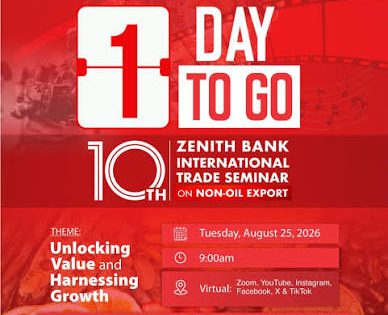
Zenith Bank Plc hosted the 10th edition of its International Trade Seminar on Non-Oil Export
on Tuesday, 25 August 2026, marking a decade of sustained advocacy for the diversification
of Nigeria’s economy. The virtual event brought together policymakers, regulators, exporters,
manufacturers, investors and development partners from across Africa and beyond, all
focused on one question: how Nigeria can earn more from what it sells to the world.
Held under the theme “Unlocking Value and Harnessing Growth”, the seminar examined
how Nigeria can move beyond exporting raw commodities to building competitive value
chains, strengthening trade infrastructure and financing, and deepening the sector’s
contribution to sustainable economic growth.
In her welcome address, the Group Managing Director/Chief Executive Officer of Zenith
Bank Plc, Dame (Dr.) Adaora Umeoji, OON, paid tribute to the Bank’s Founder, Dr. Jim
Ovia, CFR, whose vision gave birth to the seminar in 2015, and urged participants to turn
Nigeria’s improving export numbers into lasting economic value.
In her words: “Our theme, ‘Unlocking Value and Harnessing Growth’, is not just a slogan. It
speaks to the opportunities before us and the need to translate our collective efforts into
sustainable economic value. According to the Nigerian Export Promotion Council, Nigeria’s
non-oil exports reached a record $6.1 billion in 2025, up 11.5 per cent from the $5.46 billion
recorded in 2024, and a remarkable leap from the $612 million recorded a decade earlier.
Through our partnership with the African Continental Free Trade Area Secretariat, we have
commenced the development of the SMARTAfCFTA portal, and our integration with the Pan-
African Payment and Settlement System is making cross-border business easier for our
customers. Wherever our exporters need to reach, Zenith Bank will reach with them.”
She commended His Excellency, President Bola Ahmed Tinubu, GCFR, for the structural
reforms creating a more enabling environment for businesses, and the Central Bank of
Nigeria, under Governor Olayemi Cardoso, for reforms that have improved foreign exchange
stability and market confidence. “As we build on the progress recorded so far,” she added, “it
is important that, as a nation, we accelerate growth by creating more value locally and
exporting finished products, rather than just raw materials.”
Delivering the keynote address, the Honourable Minister of Industry, Trade and Investment,
Dr. Jumoke Oduwole, MFR, called for deeper trade and investment reforms, a better export
environment and wider market access within Africa and beyond. “The question before us
now is not simply how to export more, but how to retain more value in Nigeria from
everything we export,” she said. “Our focus at the Ministry is straightforward: produce more
competitively in Nigeria, process more in Nigeria, connect Nigerian businesses to bigger
markets, and ensure that the financing, infrastructure and trade systems exist to help them
scale. In July, I assumed the chair of the AfCFTA Council of Ministers, and I see at first hand
that the opportunity before us goes beyond the size of the African market of over 1.4 billion
people and approximately $3.4 trillion in GDP. It is about enabling Nigerian firms to sell more
products, reach more markets and deepen regional value chains. Nigeria’s role as an
AfCFTA digital trade co-champion further positions us to help shape how this market
evolves, particularly as digital trade creates new pathways for Nigerian businesses to reach
customers across the continent.” She urged financial institutions to go beyond financing
export transactions to financing export capability, and encouraged Nigerian businesses to
prepare for intra-African trade by investing in productivity, quality and skills.
In his presentation, the Chair of the Board of Directors of the Fund for Export Development
in Africa (FEDA) and immediate past President/Chairman of Afreximbank, Professor
Benedict Oramah, GCON, argued that the moment demands new thinking. “The theme
chosen for this 10th edition is both apt and timely,” he said. “The global economy is
experiencing unprecedented levels of entropy. I do not raise this to alarm us. I raise it
because a unique opportunity lies ahead of us that may well pave the way to Africa’s
ascendance. The question is no longer whether Africa can attract enough external capital
and external demand to power its growth. The question is whether Africa, and Nigeria within
it, can build her own internal demand, participate effectively in global supply chains, build the
capacity to finance her own trade and industries, and create her own markets.” He
commended Zenith Bank and its leadership for advancing Nigeria’s non-oil export agenda
over the past decade.
The Founder and Executive Chair of Plot Enterprise Ghana Limited, Mrs Patricia Poku-
Diaby, made the case for transformation plainly. “Let us make no mistake: the future of our
economy will not be determined simply by what we grow or what we mine, but by what we
transform,” she said. “We need to move from being suppliers of raw materials to becoming
producers, processors, manufacturers, exporters and owners of strong African brands. Our
focus should be on creating more value before our products leave our shores.”
Speaking on the Nigeria-United Kingdom trade relationship, the UK Minister of State at the
Ministry of Housing, Communities and Local Government, the Rt. Hon. Florence Eshalomi,
MP, represented by Ms Mujina Kaindama, Head of Trade Policy for UK Business,
Innovation, Science and Trade, commended the Bank for the platform. “The trade
relationship between the United Kingdom and Nigeria is one of immense importance and
even greater potential,” she said. “Nigeria is home to extraordinary entrepreneurial talent,
innovation and creativity. One of the most promising opportunities lies not simply in
increasing exports, but in increasing the value of those exports: moving further up the value
chain, processing raw materials, developing branded products and creating higher-value
manufactured and agricultural goods. In doing so, Nigerian businesses can unlock greater
returns, create jobs and build sustainable economic growth.”
The Secretary-General of the African Continental Free Trade Area Secretariat, His
Excellency Wamkele Mene, placed the private sector at the centre of the continent’s
economic restructuring. “The private sector is at the heart of the fundamental restructuring of
Africa’s economy that all of us want to see,” he said, “and the seminar Zenith Bank has
convened strikes at the heart of that objective: reducing the reliance of exports on
unprocessed commodities and accelerating industrialisation and value addition in Africa. The
success of the AfCFTA will ultimately be measured not by how many protocols and legal
instruments have been signed, but by the extent to which our private sector can leverage the
AfCFTA to access new markets, scale their investment and scale their productive capacity to
create jobs across the continent.”
The seminar featured two panel sessions. The public sector panel brought together Mr
Abubakar Bello, Managing Director of the Nigerian Export-Import Bank (NEXIM),
represented by Mr Hope Nyongo, Technical Adviser; Mr Adewale Adeniyi, MFR,
Comptroller-General of the Nigeria Customs Service; Dr Abubakar Dantsoho, Managing
Director/CEO of the Nigerian Ports Authority, represented by Mr Adebowale Lawal, Ports
Manager, Lagos Ports Complex; Ms Aderinola Shonekan, Director, Trade and Exchange
Department, Central Bank of Nigeria; Mrs Nonye Ayeni, Executive Director/CEO of the
Nigerian Export Promotion Council; and Mr Adekunle Ajai, General Manager, Neroli
Technologies. The panellists committed to improving trade facilitation, customs efficiency,
logistics reform, trade advocacy and exporters’ access to funding.
The private sector panel featured Alhaji Adeniji Adeyemi, MD/CEO of Starlink Global & Ideal
Limited; Alhaji Sada Ladan-Baki, Group Executive Director, International Trade and Export,
Dangote Group; Mr Bamidele Ayemibo, Senior Consultant, 3T Impex Trade Centre; Mr
Mobolaji Salako, Managing Director, Terra Aqua Environmental Consultancy Nigeria Limited;
Mr Ramzi Taher, Managing Director, RMM Global Company Limited; Mrs Oluyemisi
Iranloye, Founder/Managing Director, Psaltry International; and Chief (Mrs) Chinwe Ezenwa,
MD/CEO, Lelook Nigeria Limited. Their discussions centred on trade barriers, value creation
and addition, competitiveness, product certification, market intelligence and the structured
financing needed to scale non-oil exports.
The Zenith Bank International Trade Seminar on Non-Oil Export was launched in 2015 to
drive dialogue and action around Nigeria’s non-oil export potential. Ten years on, the Bank
continues to champion the sector’s growth by opening up market opportunities and backing
exporters with financing, incentives and practical support.
The 2026 edition streamed live on Zoom, YouTube, Instagram, Facebook, X and TikTok,
drawing thousands of participants from 97 countries. The tenth edition closed the way the
first began a decade ago: with a commitment to give Nigerian businesses the tools,
partnerships and capital they need to compete in regional and global markets.